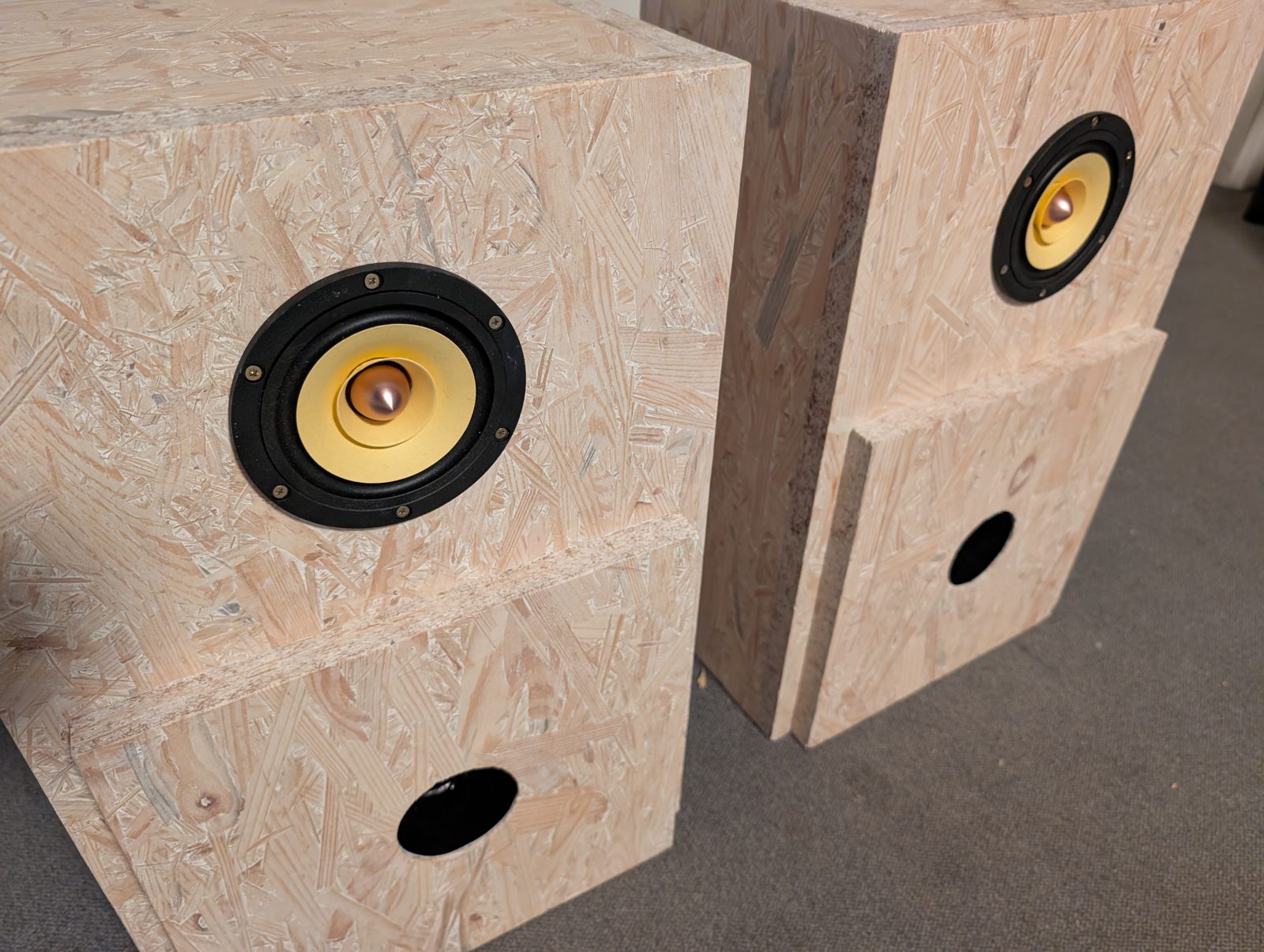
Le Petit on a budget
Jean Hiraga's Le Petit from a single sheet of OSB, with an affordable Aiyima 4" full-range driver — built on a budget and tuned by measurement, one change at a time.
All files, drawings and data: https://github.com/rich1704/le-petit-on-a-budget
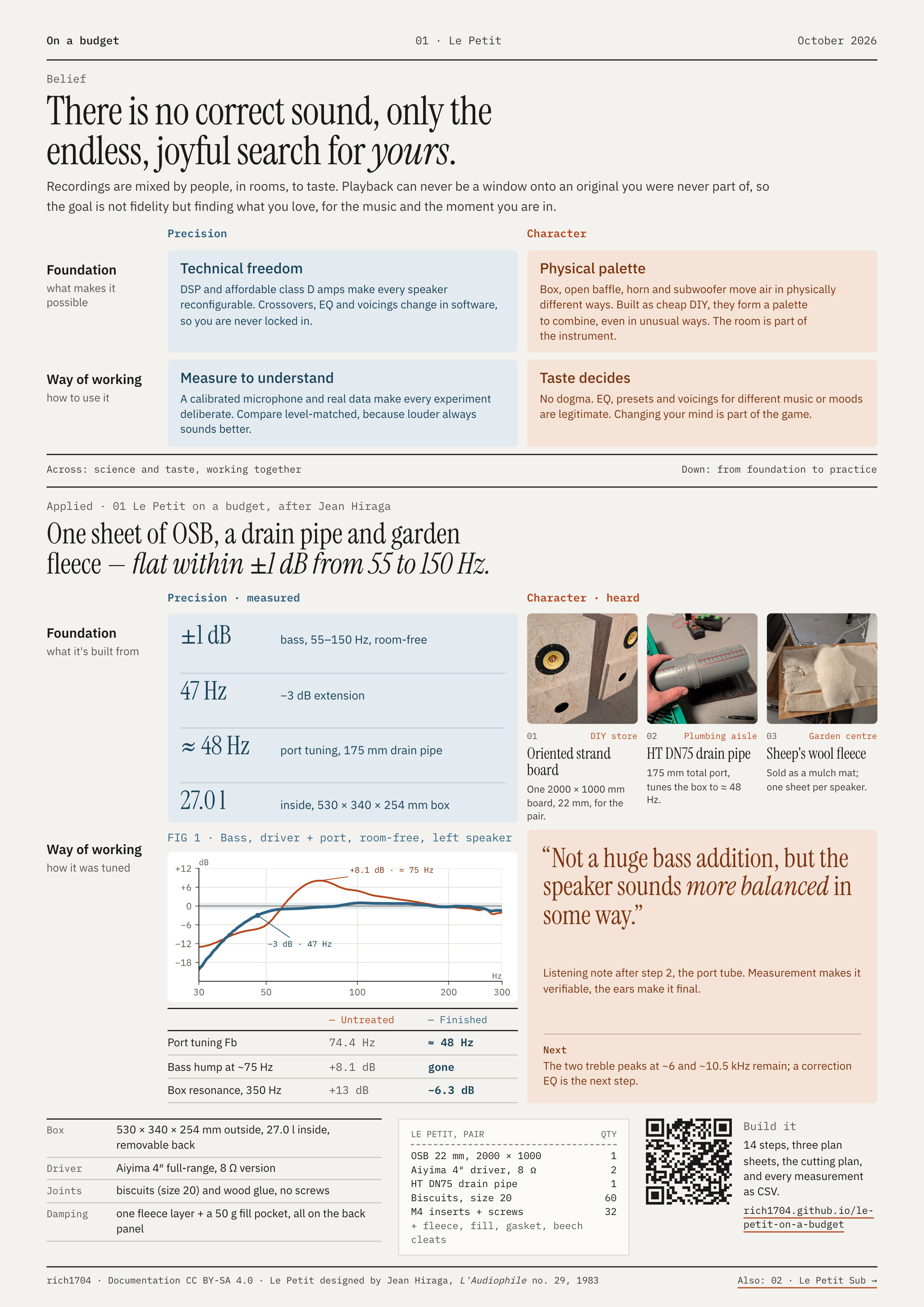
One-sheet · A4
The whole project on one page — the belief behind it, what was measured and what was heard. Open the one-sheet →
In short
- One 2000 × 1000 mm board of 22 mm OSB for the pair, a drain pipe as the port tube, one sheet of sheep's wool fleece per speaker for damping.
- Bass flat within ±1 dB from 55 to 150 Hz, down to 47 Hz — the box with this driver and the original bare port had a +8 dB boom at 75 Hz.
- Box resonances −5 to −6 dB with a damping layout that fits on the back panel.
- Every step measured and documented, with all raw data as CSV — build it, or check it.
Contents
The result · Build it · Port tube · Damping · The driver · How it was measured · What I'd do differently · Repository map · Credits
The result
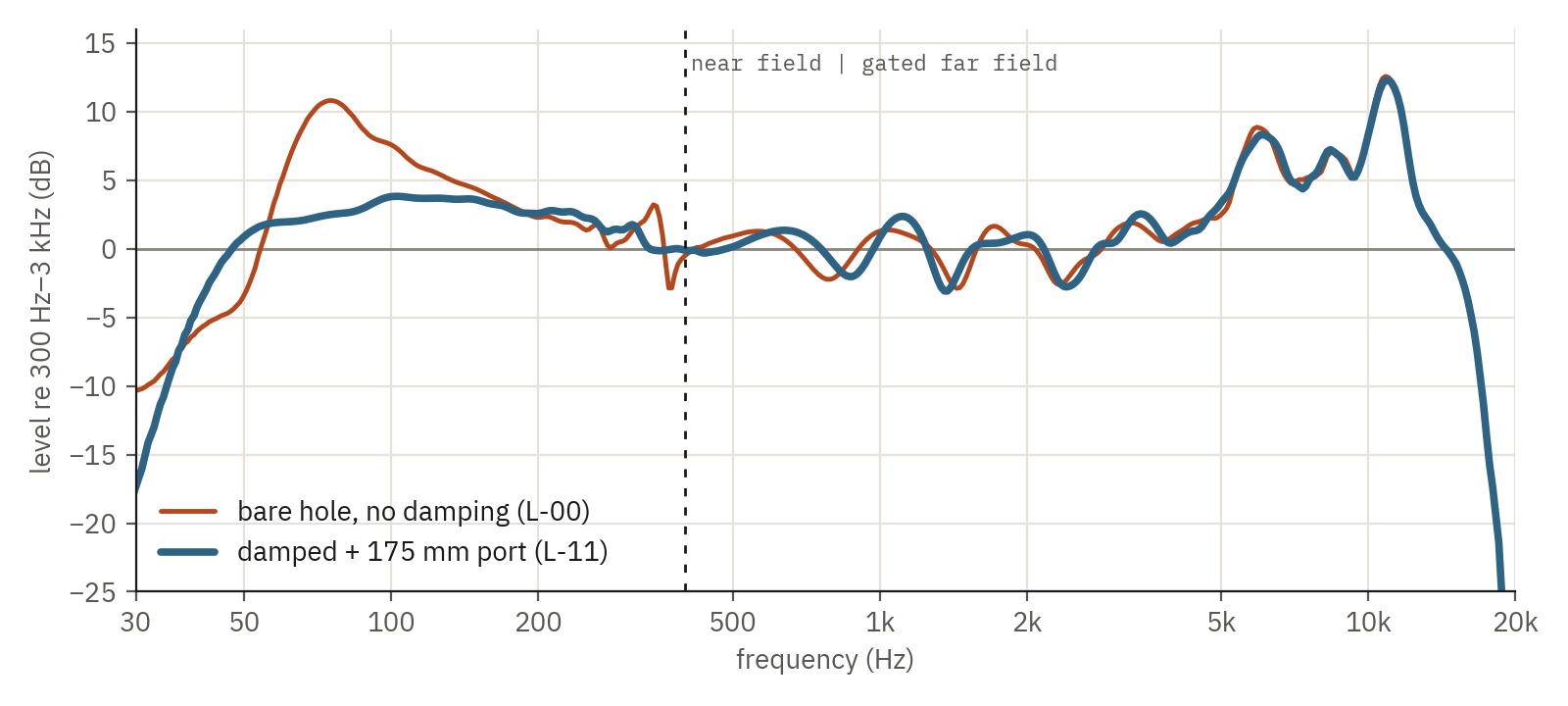
Left speaker, 30 Hz–20 kHz, room-free. Terracotta: the untreated box. Blue: damped, with the 175 mm port. Below 400 Hz the near-field driver + port sum, above it the time-gated far field.
| Untreated box | Damped + 175 mm port | |
|---|---|---|
| Port tuning Fb | 74.4 Hz | ≈ 48 Hz |
| Bass hump at ~75 Hz | +8.1 dB | gone (flat ±1 dB, 55–150 Hz) |
| Bass extension (−3 dB) | 54 Hz | 47 Hz |
| Box resonance at 350 Hz (port output) | +13 dB spike | −6.3 dB |
| "Honk" at ~950 Hz / ~1.5 kHz | clear peaks | −4.7 / −6.0 dB |
| Direct sound 300 Hz–4 kHz | ±2–3 dB | unchanged |
±1 dB bass, 55–150 Hz
47 Hz −3 dB extension
≈ 48 Hz port tuning, 175 mm port
27.0 l inside volume
It doesn't sound like more bass — it sounds more balanced.
The boom that read as "lots of bass" is spread evenly down to 47 Hz. Listening note, left speaker, after step 2.
The two treble peaks at ~6 and ~10.5 kHz remain; a correction EQ is the next step.
Build it
| Specification | |
|---|---|
| Box | 530 × 340 × 254 mm outside, 486 × 296 × 188 mm inside = 27.0 l, removable back |
| Material | one 2000 × 1000 mm board of 22 mm OSB (square edges), beech cleats, HT DN75 drain pipe |
| Driver | Aiyima 4" full-range, 8 Ω version (fits the Ø 94 mm cutout) |
| Joints | butt joints with biscuits (size 20) and wood glue — no screws; only the back panel is screwed, on cleats with gasket and M4 inserts |
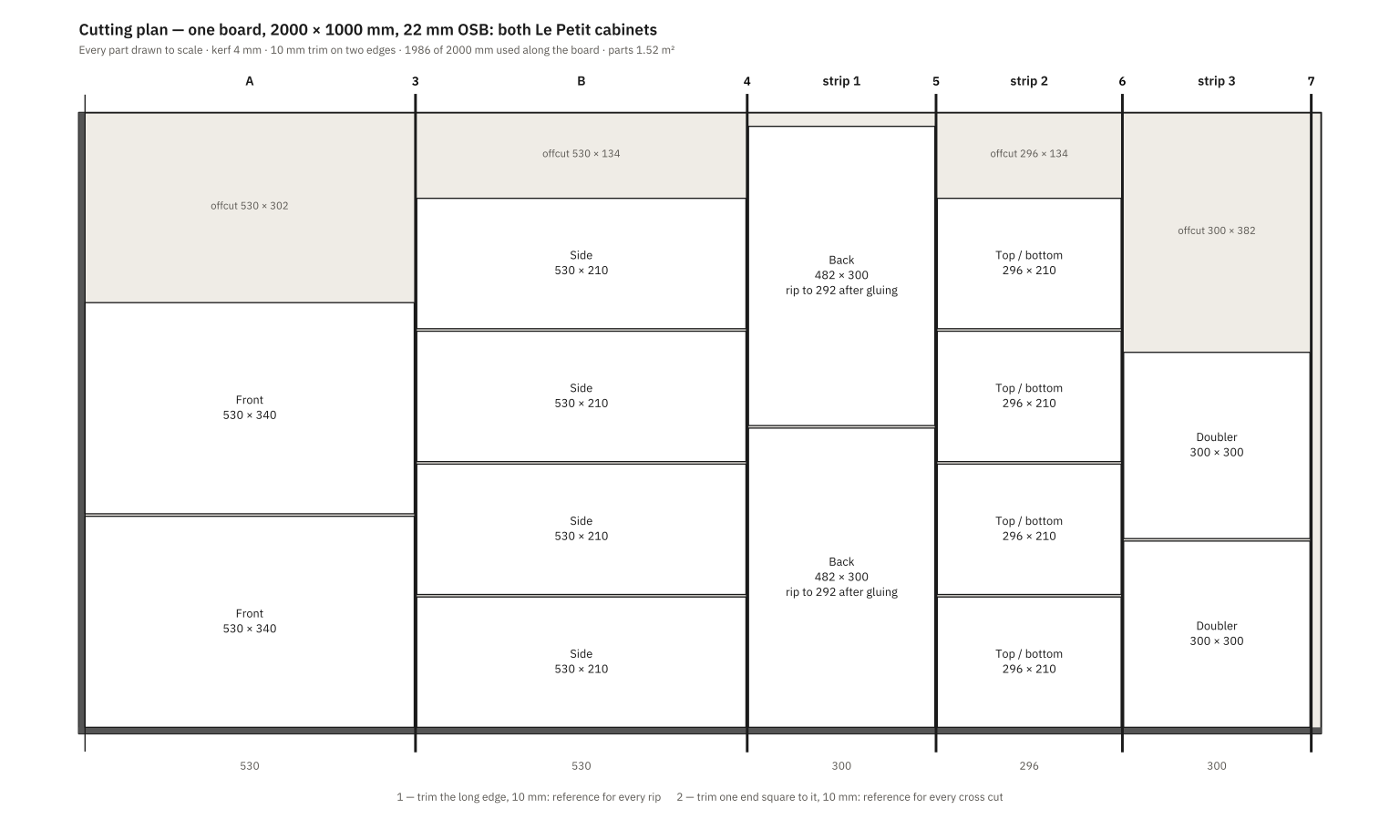
Both cabinets from one board: two edge trims, five cross cuts (530 · 530 · 300 · 296 · 300), then each piece is ripped or cut to length.
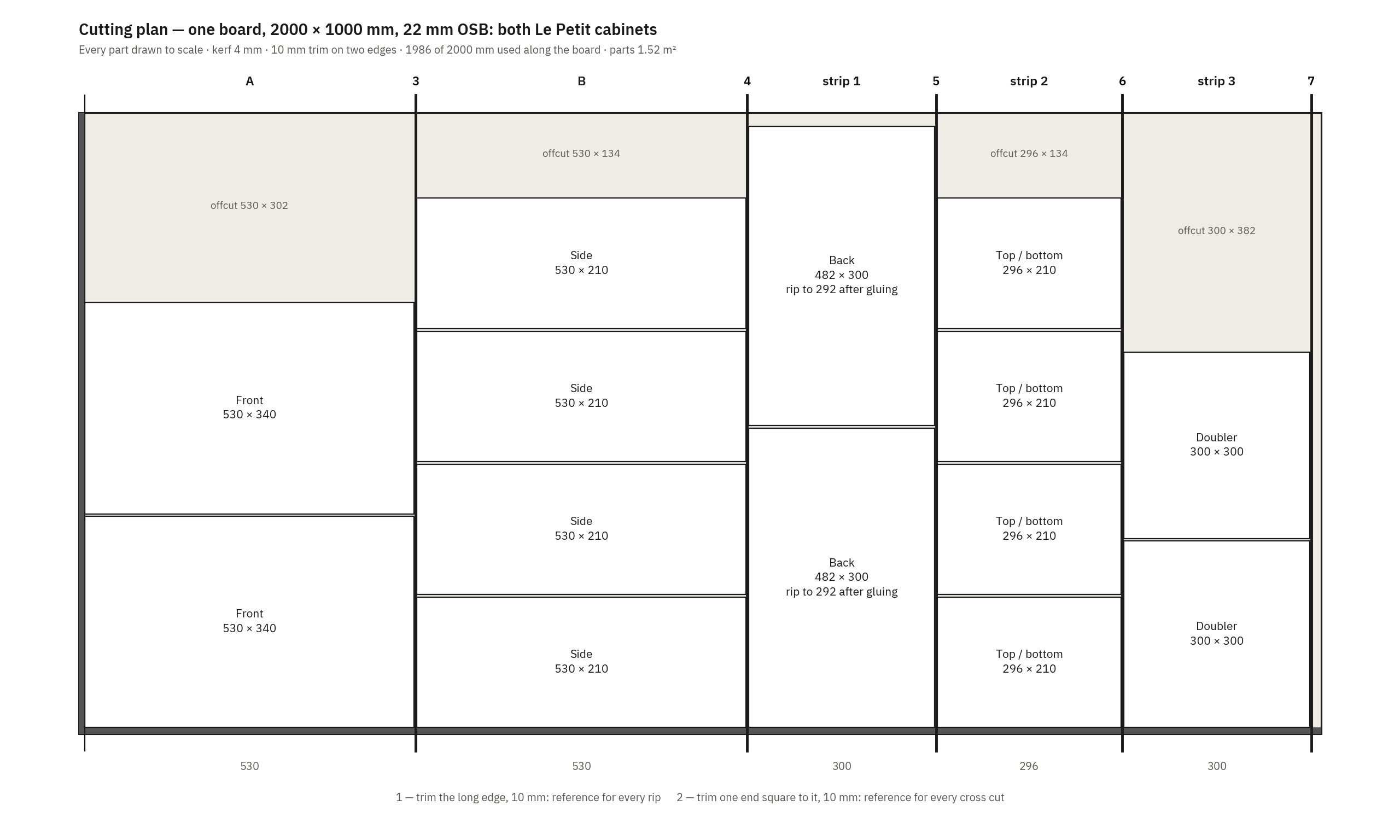
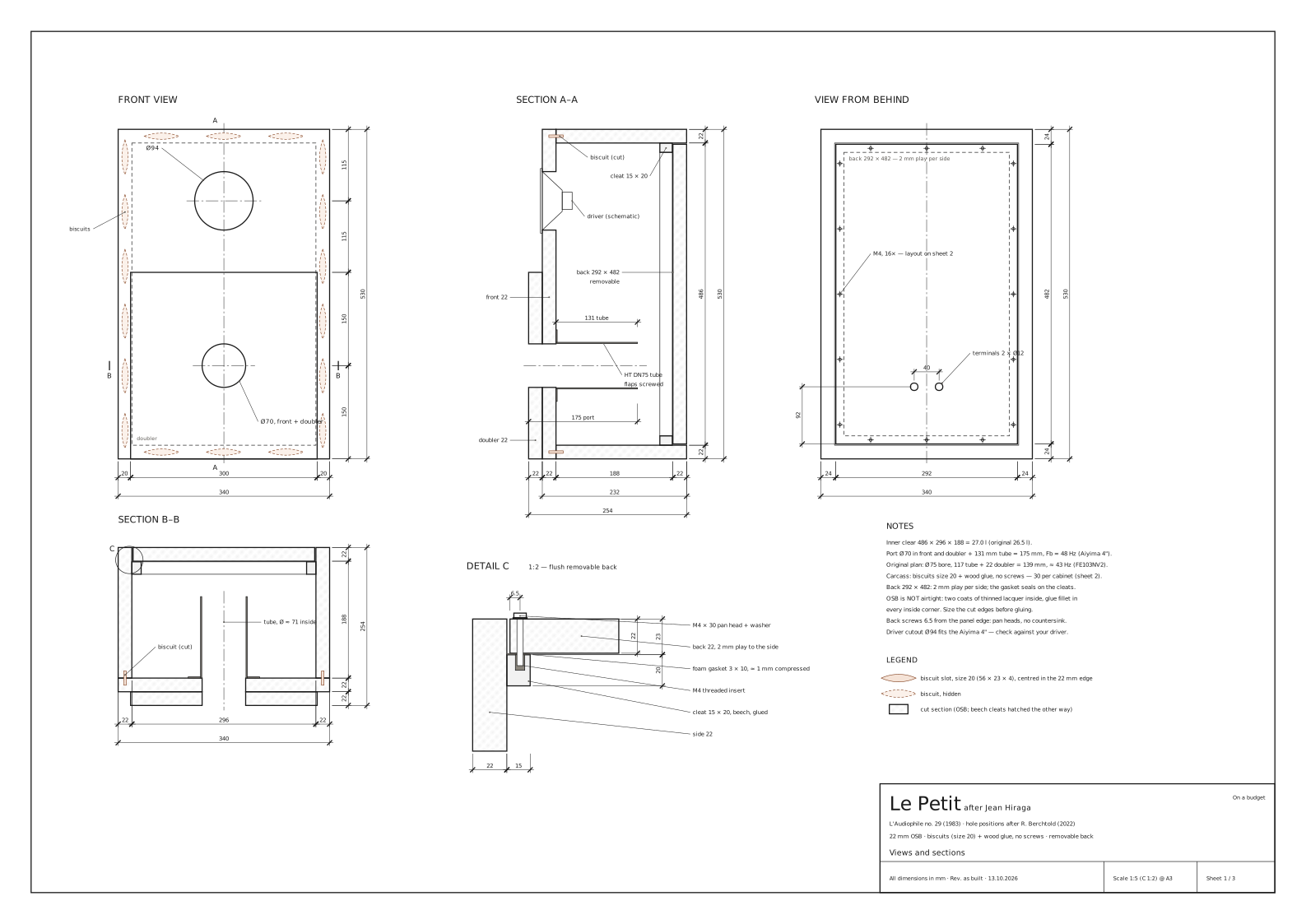
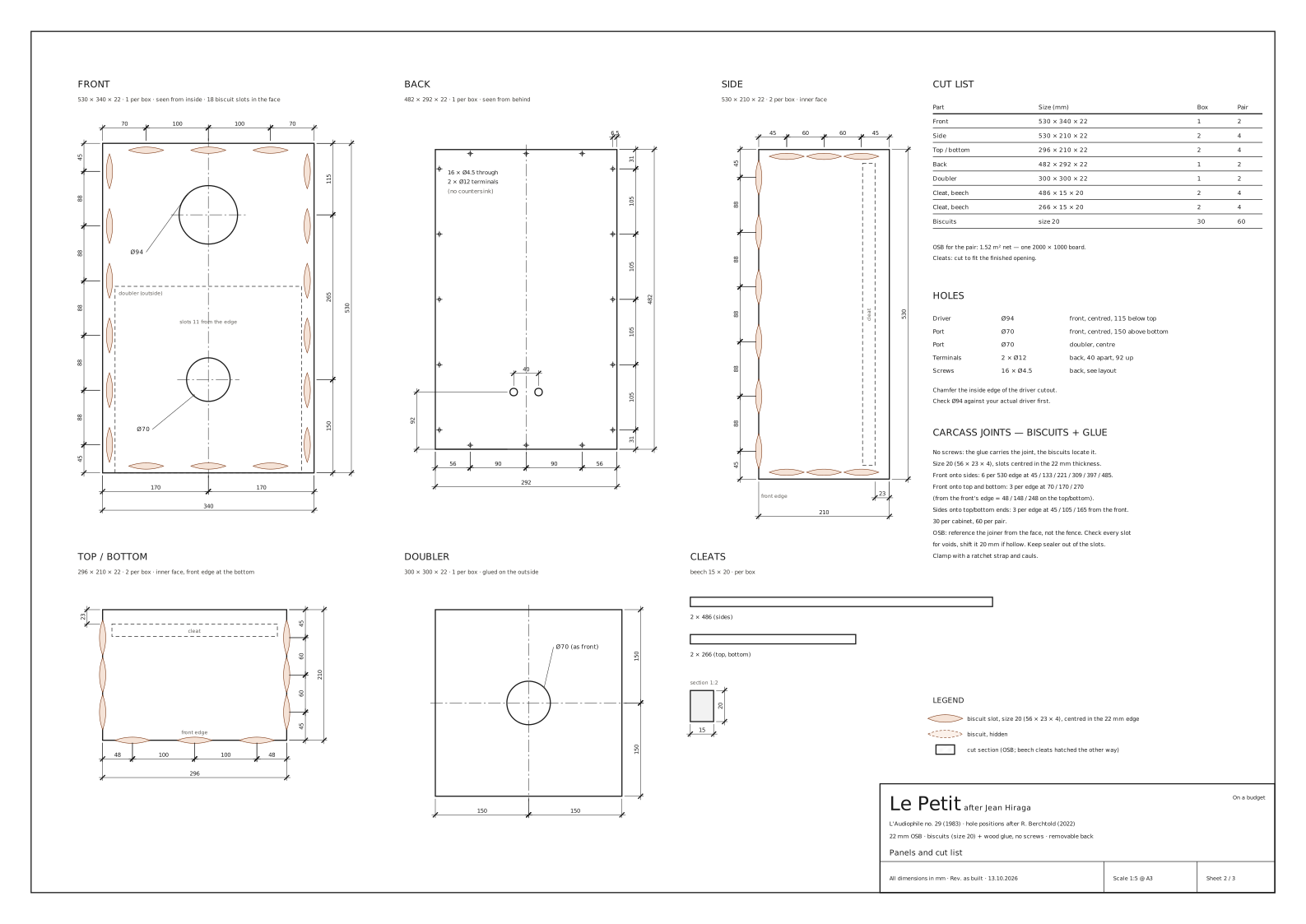
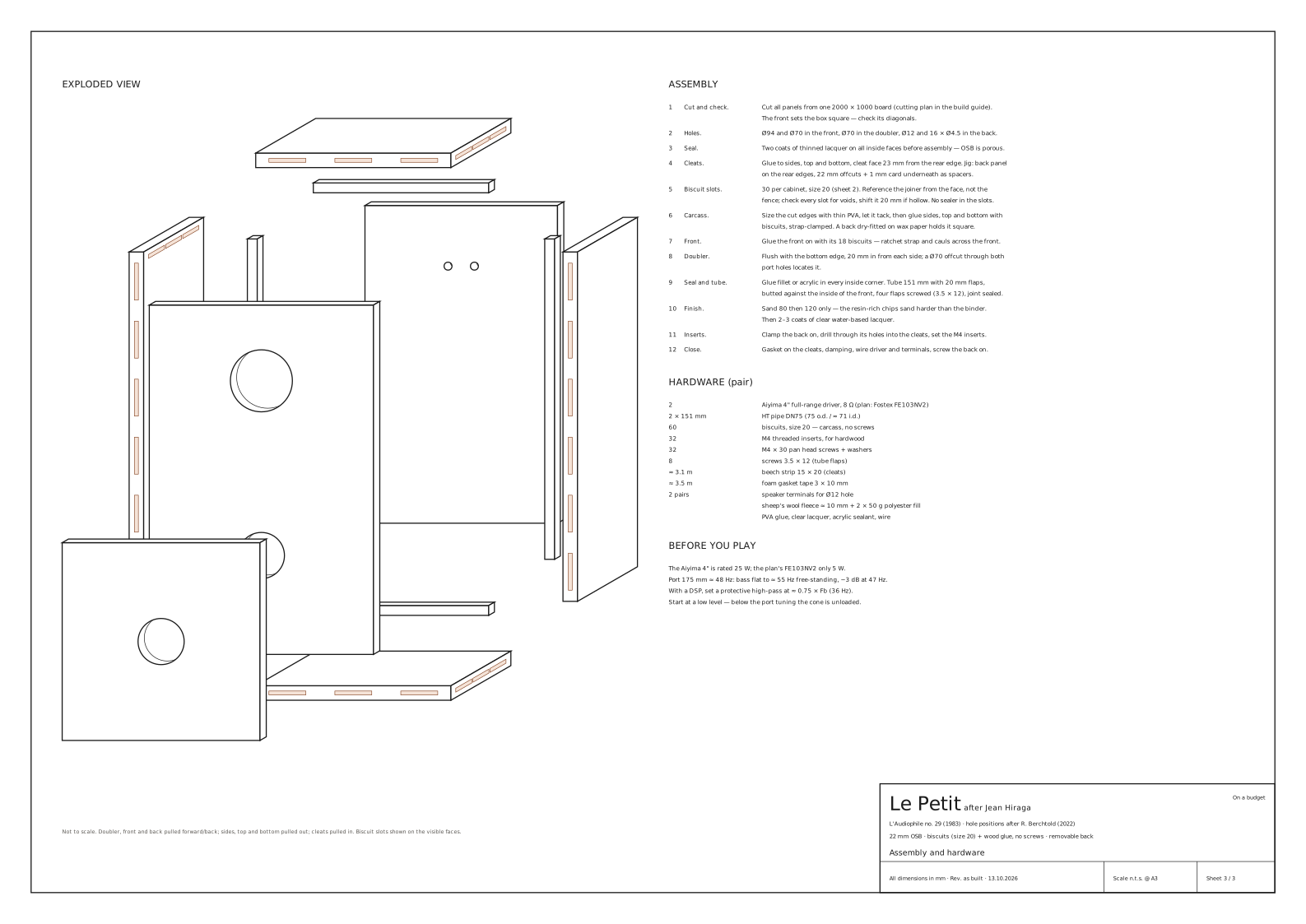
The building plan — three drawing sheets with every dimension, plus cut list, holes, biscuit positions and assembly order: docs/building-plan.md.
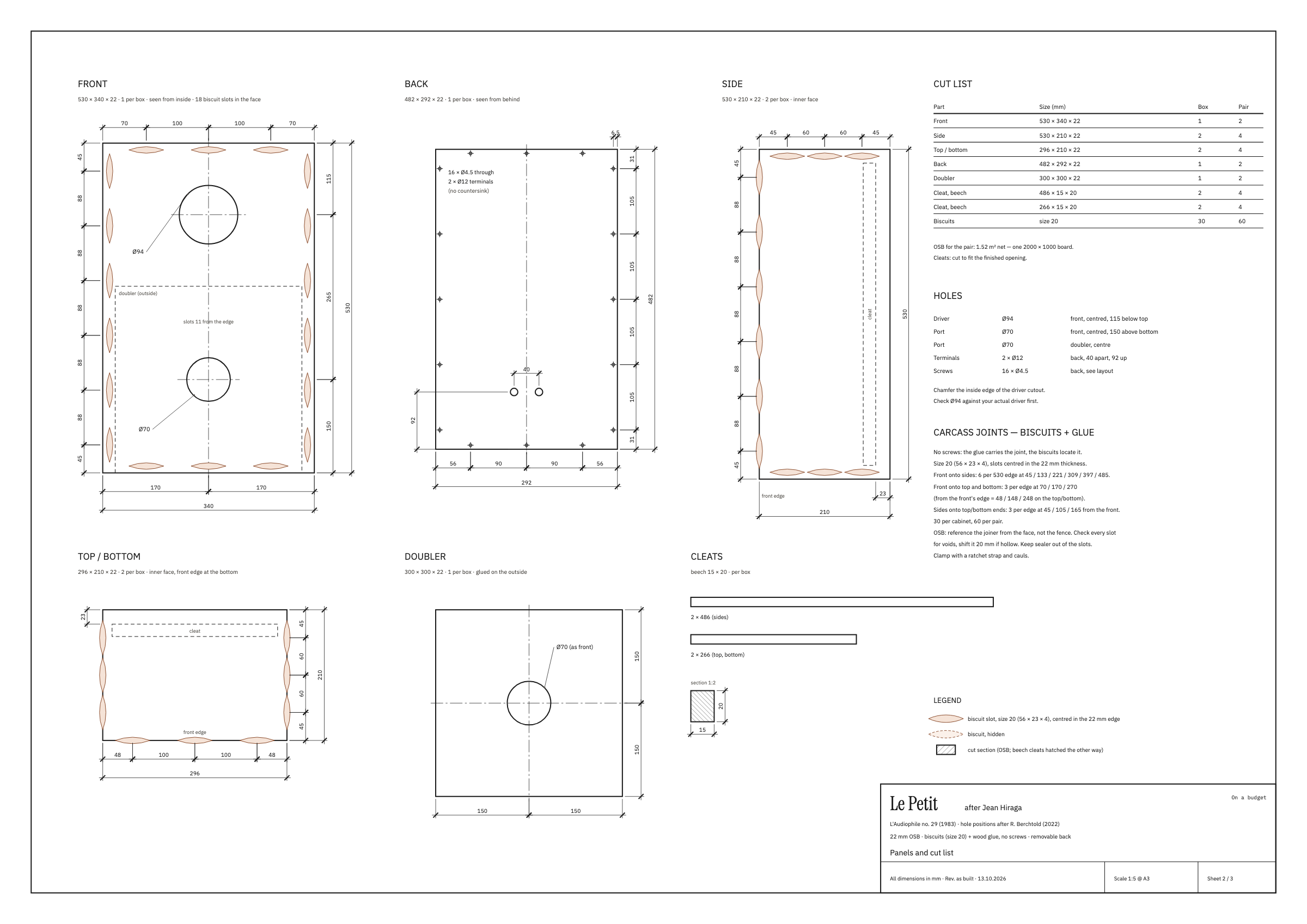
The build guide in 14 steps — docs/01-build.md:
- Cut the board (cutting plan above)
- Drill the holes — Ø 94 driver, Ø 70 port in the front and the doubler, Ø 12 terminals
- Seal the inside faces — OSB isn't airtight
- Glue the cleats 23 mm from the rear edge
- Biscuit slots and carcass — glued, no screws
- Front and doubler — glued with biscuits
- Seal the corners
- Finish
- Inserts and gasket
- Fit the back panel at 292 × 482
- Driver and wiring
- Port tube, 175 mm total
- Damping
- Close it and listen
Port tube
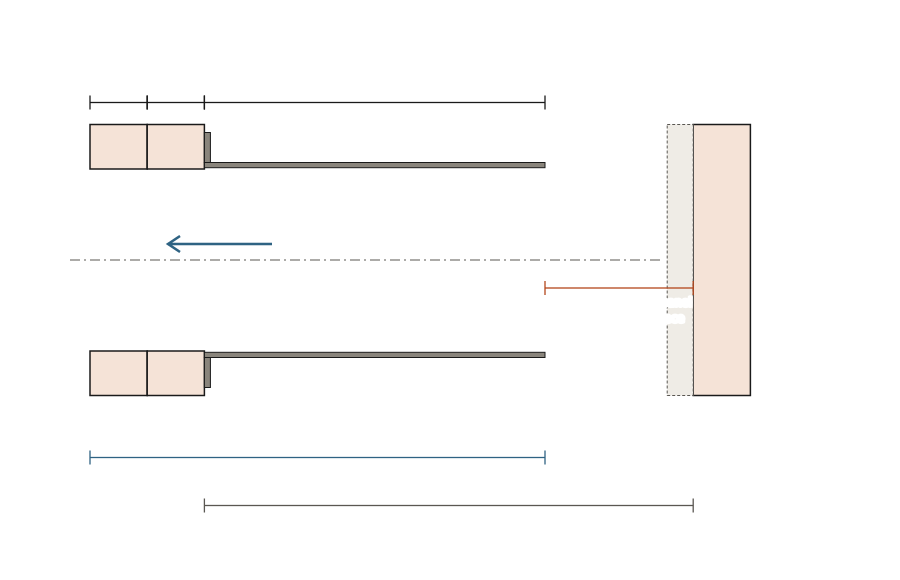
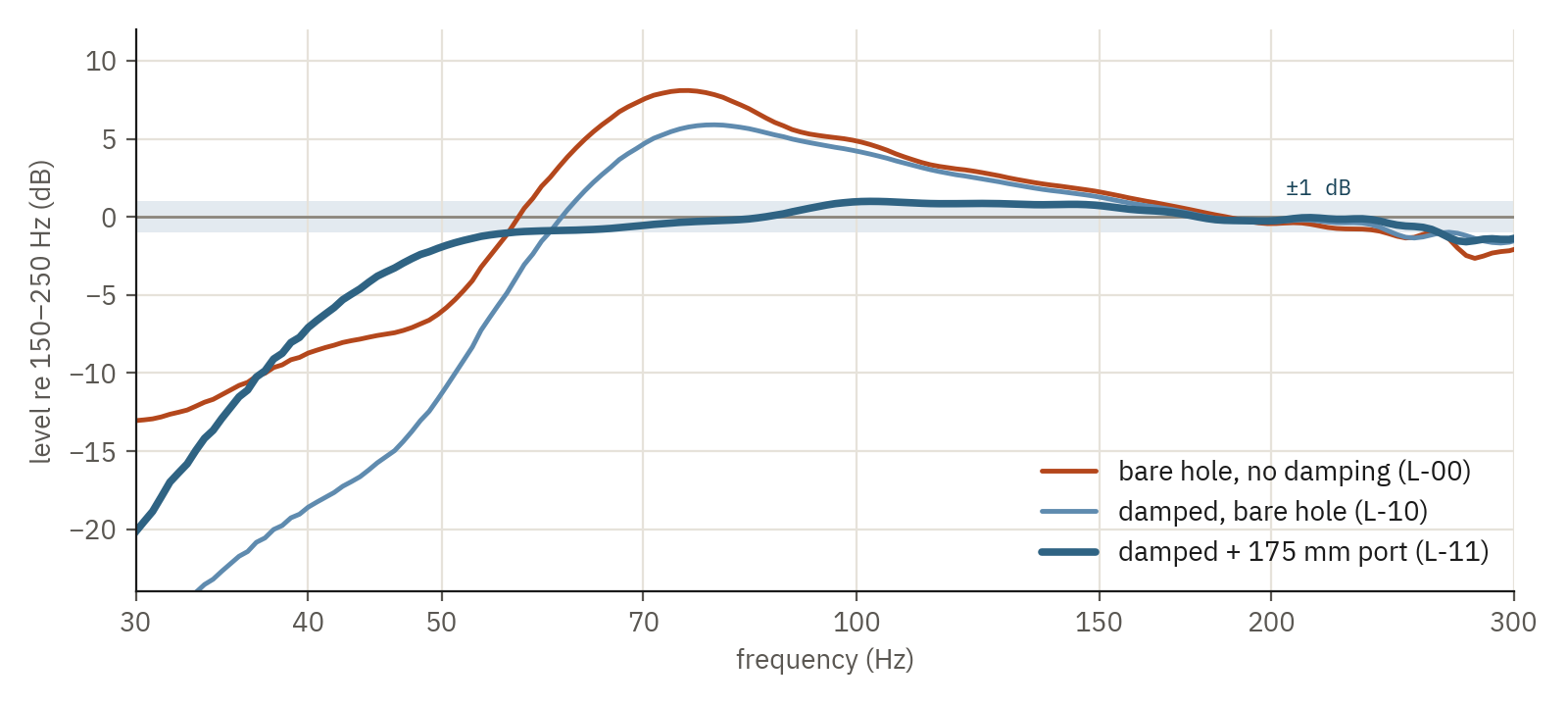
An HT DN75 drain pipe extends the port inside the box: 175 mm total, measured straight through from the tube's inner end to the doubler's outer face. That tunes the box to ≈ 48 Hz. The original 43 Hz tuning is meant for the lean Fostex FE103NV2 next to a wall; with the Aiyima it would droop early.
| Target Fb | Total port | |
|---|---|---|
| 55 Hz | 112 mm | fuller, less deep |
| 50 Hz | 146 mm | |
| ≈ 48 Hz | 175 mm | built — flat bass |
| 43 Hz (original) | 216 mm | doesn't fit the 188 mm box depth |
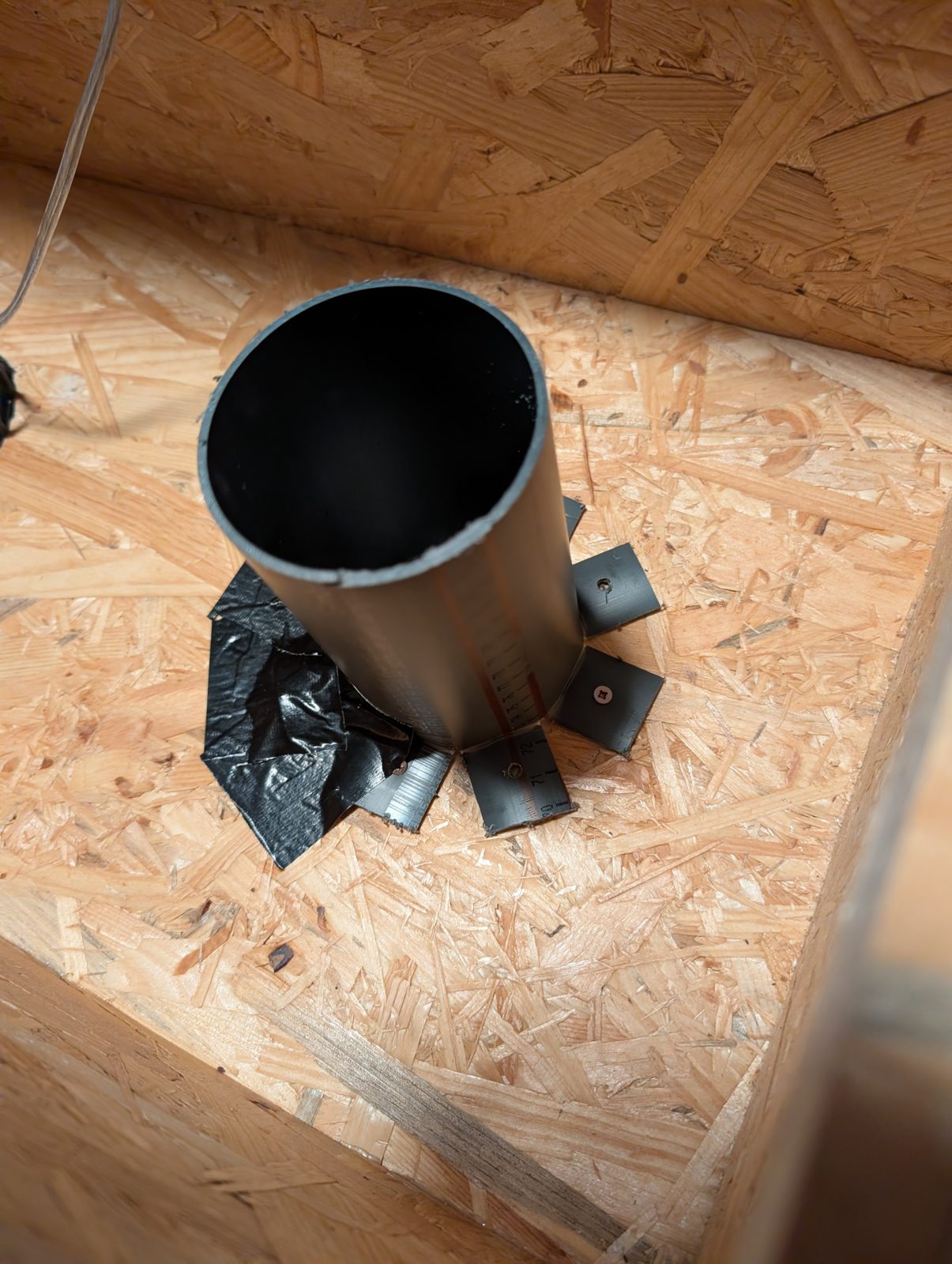
Mounted from the inside: heat-bent flaps screwed to the front panel, joint sealed. Details, prediction and measurements: docs/06-step-2-port-tube.md.
Damping
The box has three resonances that leak out of the port, and its dimensions predict them exactly:
| Resonance | From | Predicted | Measured |
|---|---|---|---|
| Height mode ("boxy") | 486 mm inner height | 353 Hz | 350–360 Hz |
| Depth mode ("honk") | 188 mm inner depth | 912 Hz | ~945 Hz |
| Port pipe resonance | 44 mm port + end corrections | ≈ 1.5 kHz | ~1.5 kHz |
Damping only works where the air moves. The layout that came out of eight measured variants:
- one layer of sheep's wool fleece (≈ 10 mm) covering the inside of the back panel (against the depth mode), and
- a wool pocket with 50 g of loose polyester fill across the middle third of the height (where the height mode moves the most air).
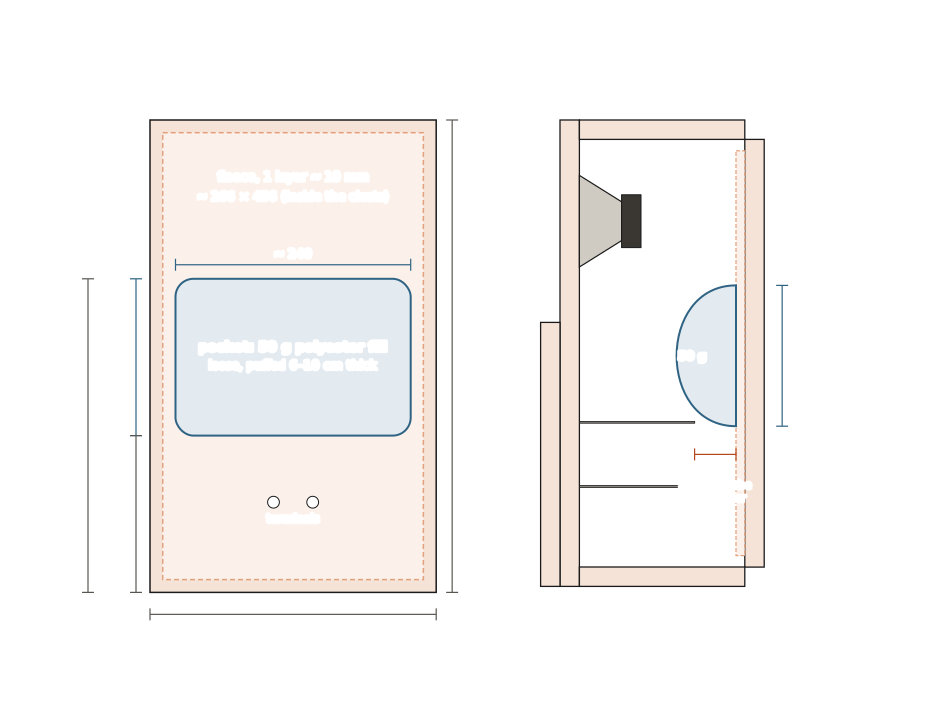
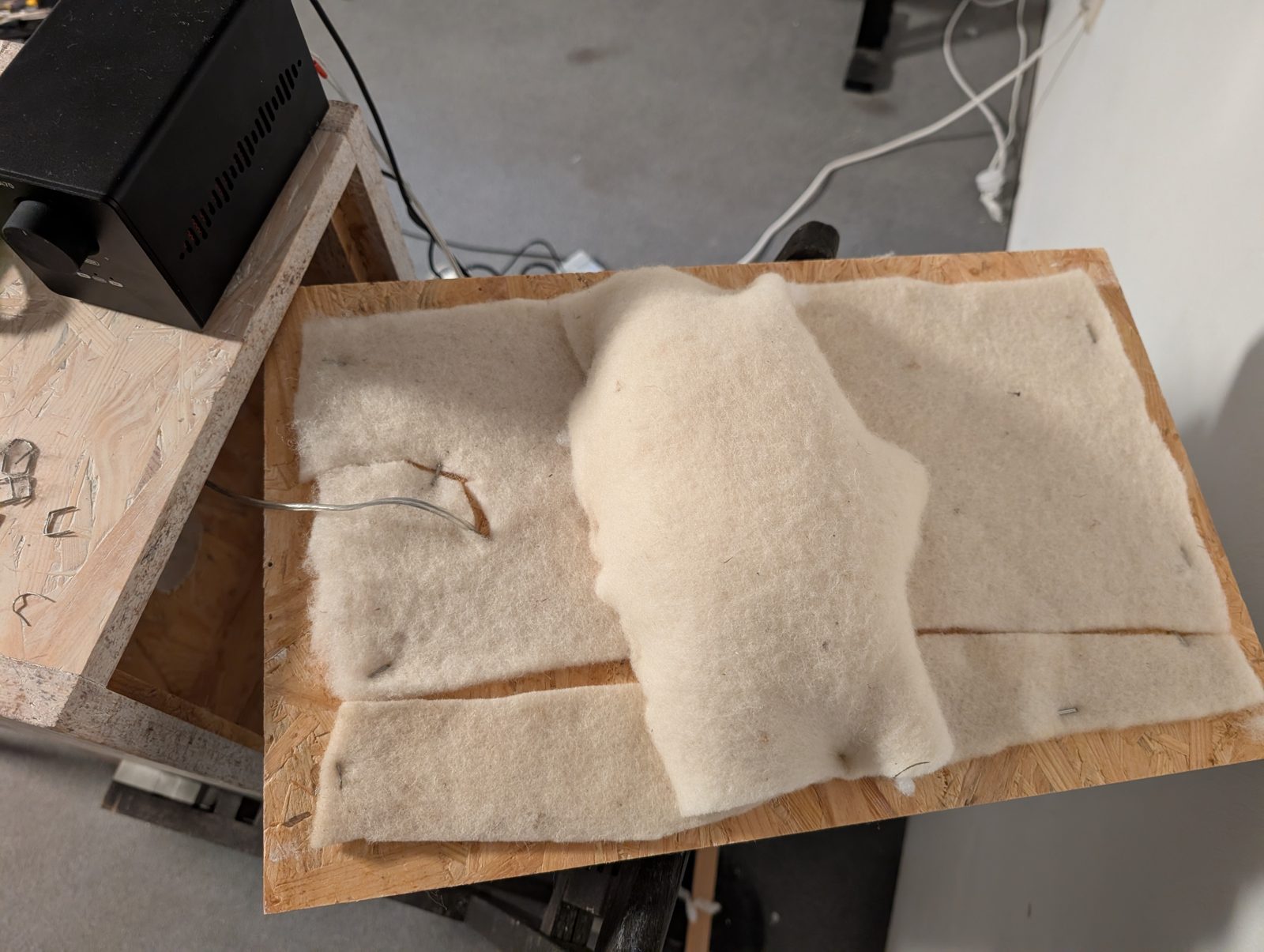
Test setup, not the finished state. The damping shown here is an experimental rig, built to compare materials and placements: fleece cut to size and stapled in, a hand-made pocket, material added and taken out again between measurements. Materials: sheep's wool garden fleece — the unbleached fleece sold as a plant-protection or mulch mat, ≈ 10 mm, 350 g per 5 × 0.5 m roll (≈ 140 g/m²) — and polyester fibre fill, the synthetic stuffing found in ordinary pillows. The finished speakers get the same layout made neatly: fleece cut to the panel, a sewn pocket, fixed securely.
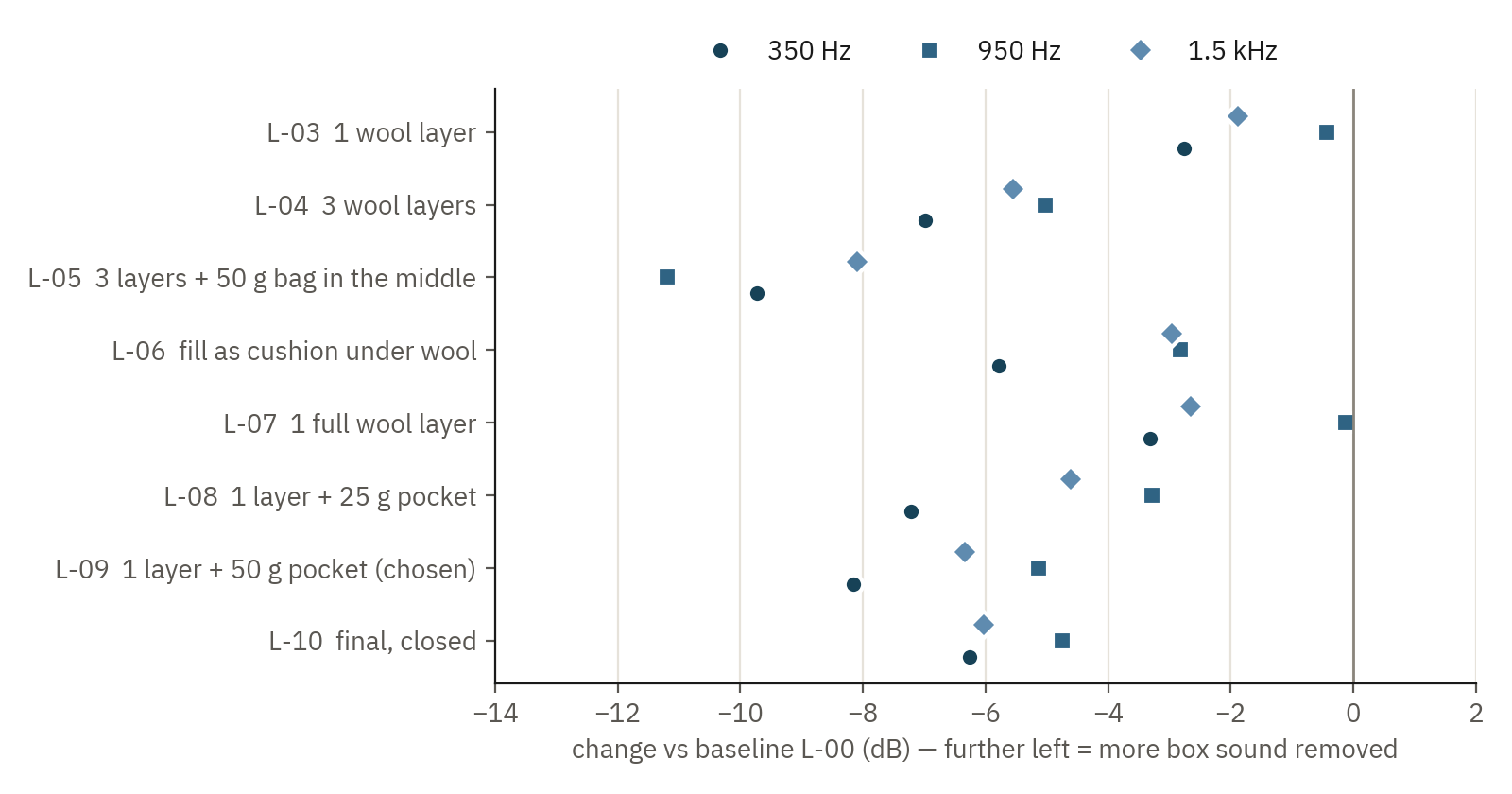
One sheet of fleece per speaker, all on the back panel, −5 to −6 dB on every resonance, direct sound unchanged. All eight variants: docs/05-step-1-damping.md.
The driver: Aiyima instead of Fostex
| Original plan (FE103NV2) | This build (Aiyima 4", 8 Ω) | |
|---|---|---|
| Power rating | 5 W | 25 W |
| Bass | lean; needs a wall or corner | more bass of its own |
| Tuning | 43 Hz (139 mm port) | ≈ 48 Hz (175 mm port) |
| Damping | box modes come from the box — the same for both |
The driver changes the port tuning, not the damping. Note: the datasheet shipped with the Aiyima (Re 3.4 Ω, Fs 73 Hz, Qts 0.52) is for the 4 Ω version; the impedance measurement showed the 8 Ω version. More: docs/07-aiyima-vs-fe103.md.
How it was measured
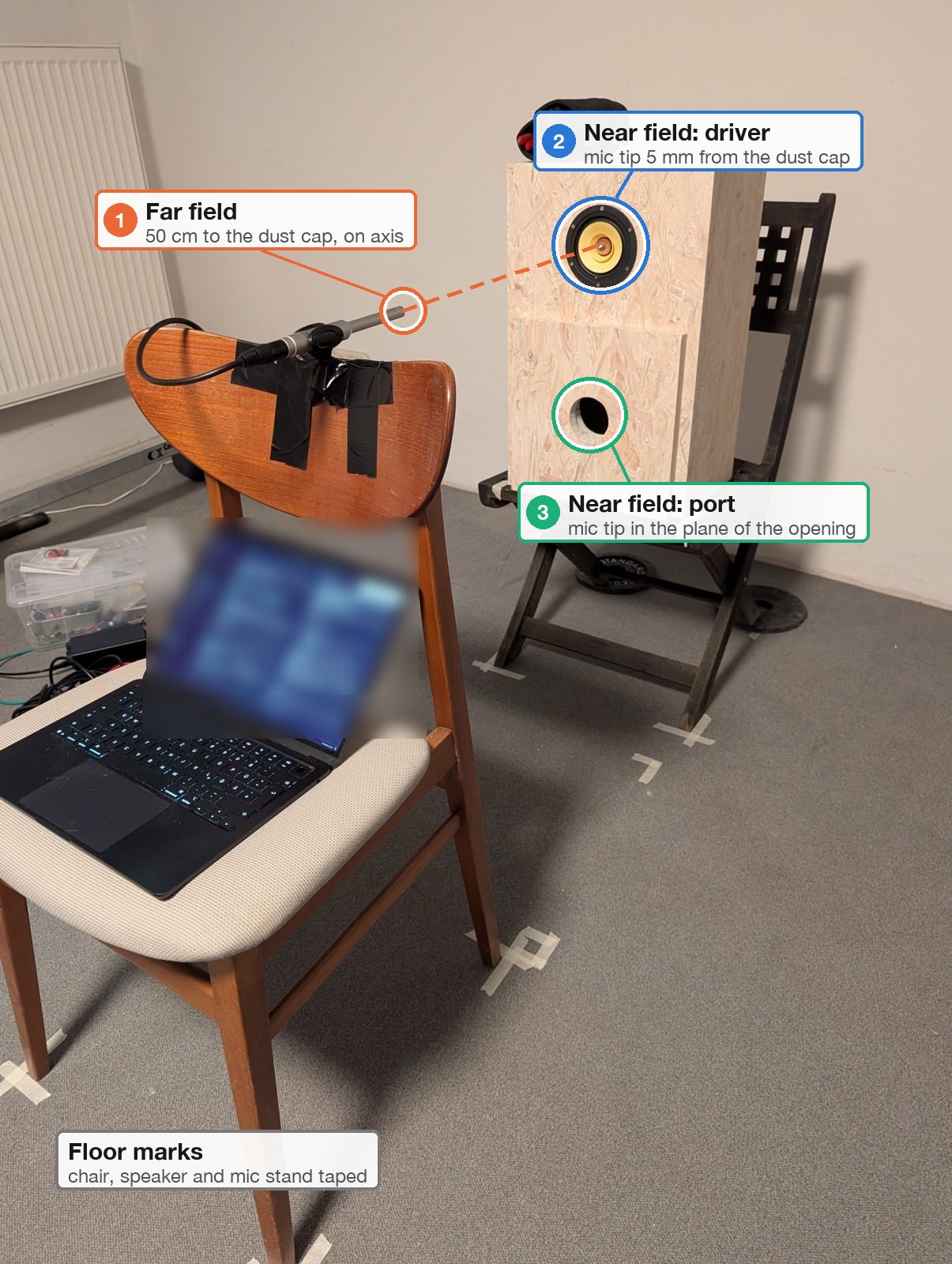
The three microphone positions: ① far field, 50 cm on axis · ② near field, 5 mm from the dust cap · ③ near field, in the port opening.
| Item | Role |
|---|---|
| Behringer UMC404 | plays the sweeps, records mic, loopback reference and the impedance jig |
| Behringer ECM8000 | measurement microphone: far field at 50 cm, near field at the cone and the port |
| Aiyima A70 | the amplifier |
| Loopback cable (OUT 2 → IN 2) | timing and level reference: cancels the interface's latency and response |
| Impedance jig — 2 × 100 Ω in parallel + jack leads | measures the port tuning to ±1 Hz, independent of the room |
Synchronized exponential sweeps, loopback-referenced deconvolution, a 3.4 ms gate before the floor reflection, near-field driver + port summed with the correct phase, one change per round, repeatability checked to 0.1–0.3 dB.
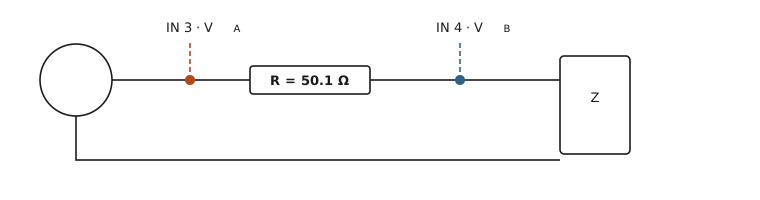
Rig: docs/02-measurement-rig.md · Jig build guide: docs/03-impedance-jig.md · Method: docs/04-method.md · Raw data: docs/data/
What I'd do differently
- Measure the impedance first. A 50 Ω resistor and two jack leads show the driver version and the real port tuning in minutes.
- Cut the back panel 2 mm smaller than the opening (292 × 482) and fit it with the gasket and screws from the plan. A friction-fit back leaks and shifts the bass every time it's refitted.
- Don't trust the port calculator for a bare hole. The box tuned to 74 Hz instead of the predicted 61 Hz. Scale the tube from a measurement, cut long, trim.
- Put the damping by the mode, not by the panel. One thin layer on its own did almost nothing against the 950 Hz "honk"; the pocket at mid-height did.
Repository map
docs/
├── 01-build.md              build guide, 14 steps, parts list, cutting plan
├── building-plan.md         the building plan: drawings, cut list, holes, joints, assembly
├── 02-measurement-rig.md    equipment, signal chain, microphone positions
├── 03-impedance-jig.md      the 50 Ω jig: parts, wiring, calibration, verification
├── 04-method.md             sweeps, windows, near-field sum, impedance estimator
├── 05-step-1-damping.md     box resonances, eight damping variants, result
├── 06-step-2-port-tube.md   port tuning from 72 to 48 Hz, result, listening test
├── 07-aiyima-vs-fe103.md    what changes with the Aiyima driver
├── 08-lessons.md            recommendations, conclusions, roadmap
├── plans/                   building-plan sheets and cutting plan (SVG) + their generator scripts
├── data/csv/                every measurement as CSV
├── data/                    raw recordings (.npz) and overview plots
└── assets/                  photos, charts, diagrams
| Folder | Contents |
|---|---|
| docs/plans/ | sheet 1 views and sections · sheet 2 panels and cut list · sheet 3 assembly · cutting plan · generators: sheets, cutting plan |
| docs/data/csv/ | frequency responses, impedance and bass sums of every session |
| docs/data/ | raw impulse responses and impedance (.npz), format description |
| docs/assets/ | photos, charts, diagrams |
Roadmap
Step 1 (damping) and Step 2 (port tube) are done for the left speaker. Next: the right speaker with the same recipe and one check measurement, finishing (tube glued, back with gasket and screws, neat damping), then a correction EQ for the treble peaks and room correction at the listening seat.
Credits and license
Le Petit is Jean Hiraga's design (L'Audiophile no. 29, 1983); hole positions after R. Berchtold (2022). This project stands on the plans and write-ups of everyone who has built it before — this is my way of giving something back. Documentation, drawings, photos and data: CC BY-SA 4.0; the cutting-plan script: MIT. Details: docs/CREDITS.md.