Step 2 — Port tube
Question: where should the damped box be tuned for the Aiyima, and how long must the tube be? Result: a 175 mm port moves the tuning from ≈ 72 Hz to ≈ 48 Hz; the +8 dB bass hump turns into a response flat within ±1 dB from 55 to 150 Hz.
Target
- After damping the bare 44 mm port tuned to ≈ 72 Hz, with a hump at ~79 Hz and a steep fall below 58 Hz.
- Target ≈ 50 Hz. The original design tunes to 43 Hz for the lean FE103NV2 plus a nearby wall; the Aiyima has more bass of its own (Aiyima vs. FE103NV2).
- Constraint: 188 mm inner depth. 43 Hz would need ≈ 216 mm of port; too close to the back panel the air at the tube's mouth gets choked.
Prediction
The tube length is scaled from the measured tuning (Helmholtz: Fb ∝ 1/√Leff, with end correction), so no box model is needed. From Fb = 72 Hz at 44 mm:
| Target Fb | Total port | |
|---|---|---|
| 55 Hz | 112 mm | fuller, less deep |
| 50 Hz | 146 mm | the target |
| ≈ 46.5 Hz | 175 mm | fitted — cut long, to trim towards 146 mm |
| 43 Hz (plan) | 216 mm | doesn't fit the 188 mm depth |
Build
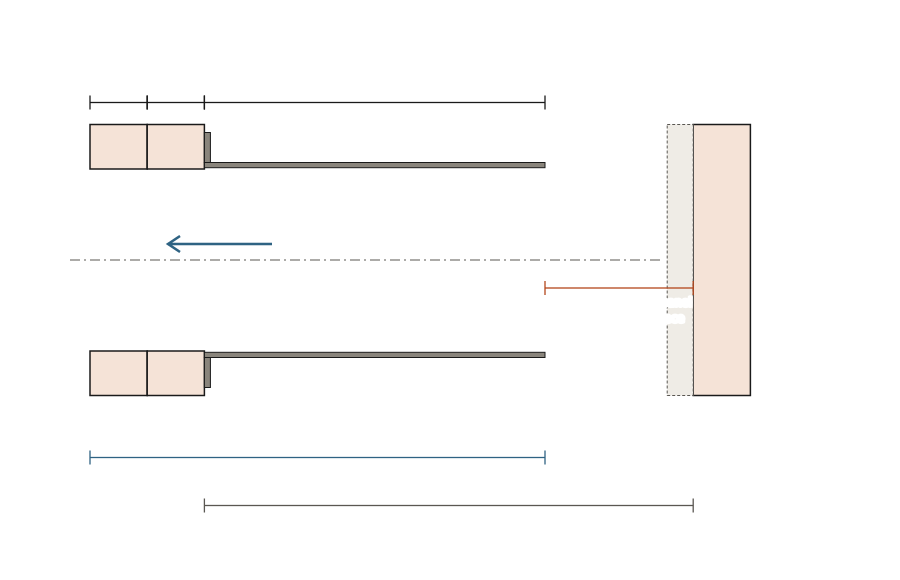
HT DN75 drain pipe, mounted from the inside against the front panel, joint sealed. Total port = tube + front panel + doubler = 175 mm, measured straight through. ≈ 4.7 cm clear to the back-panel wool. Details: Build → Port tube.
Verification
Four independent checks, then the ears:
- Impedance (
L-z-02;L-z-03with all seams and the tube base taped, to rule out leaks). - Port near field — where the port's output peaks is Fb.
- Bass sum (cone + port, complex, area-scaled) — its shape decides whether the tuning is right.
- Far field at 50 cm — gated (direct sound) and 300 ms (in the room).
- Listening A/B — left (tube) against right (same damping, no tube) with equal-level test signals.
Reference control — two gain knobs had moved between sessions. The loopback gain was reset with a tone sent only to the loopback (back to −22.3 dBFS, as in every earlier session); the mic gain was matched so the cone's output at 100–200 Hz equals the pre-tube session within 0.5 dB — a range no port can change. Far-field fingerprint afterwards: mic −10.9 dBFS (was −11.6), loopback −22.2 dBFS, arrival 1.63 ms.
Results
The speaker now, 30 Hz–20 kHz, room-free:
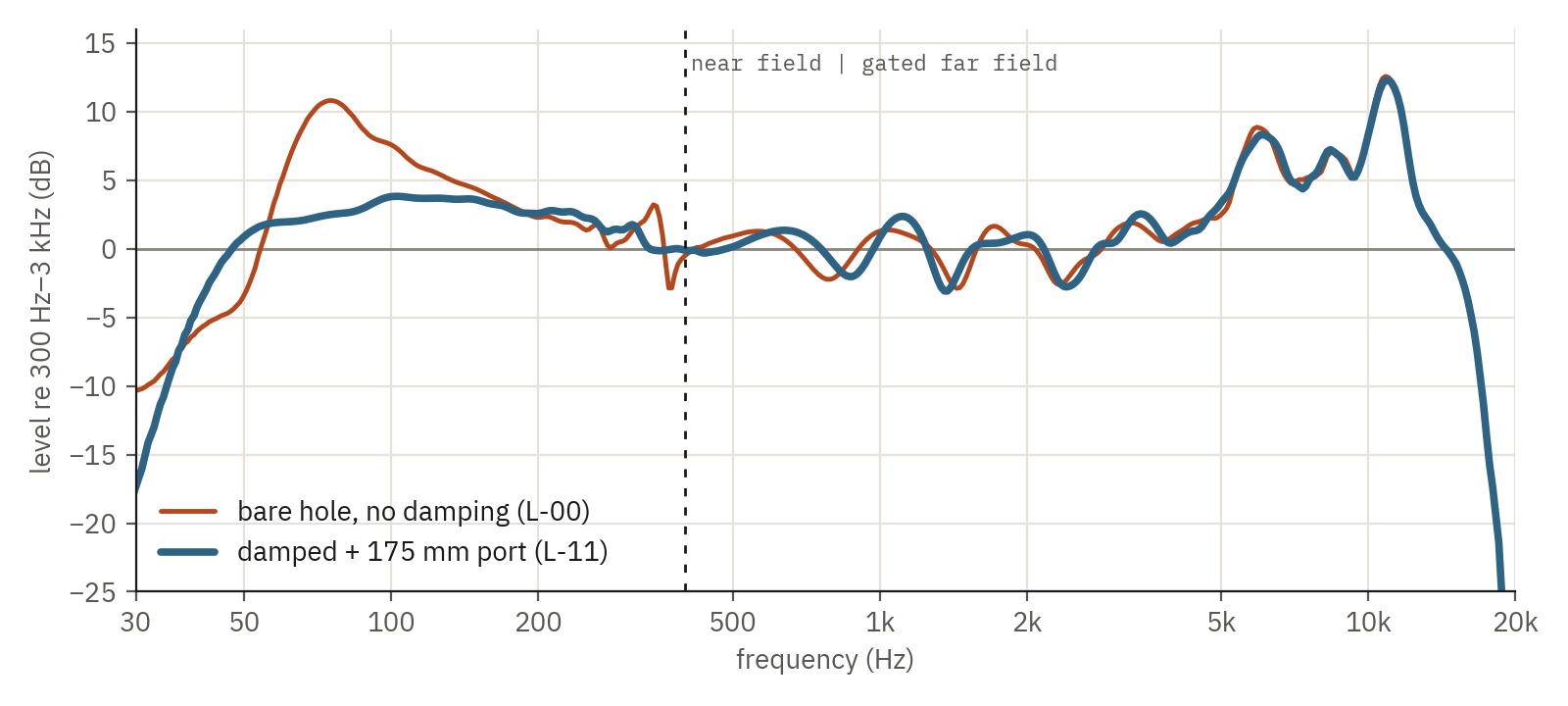
Below 400 Hz the near-field cone + port sum, above it the 3.4 ms gated far field, level-matched at the splice. From ~45 Hz to 4 kHz within about ±4 dB; the bass hump is gone. Two things remain: the treble peaks at ~6 and ~10.5 kHz (for a correction EQ), and the near-field part is half-space — free standing, the bass sits a few dB lower relative to the mids (baffle step), which a nearby wall gives back.
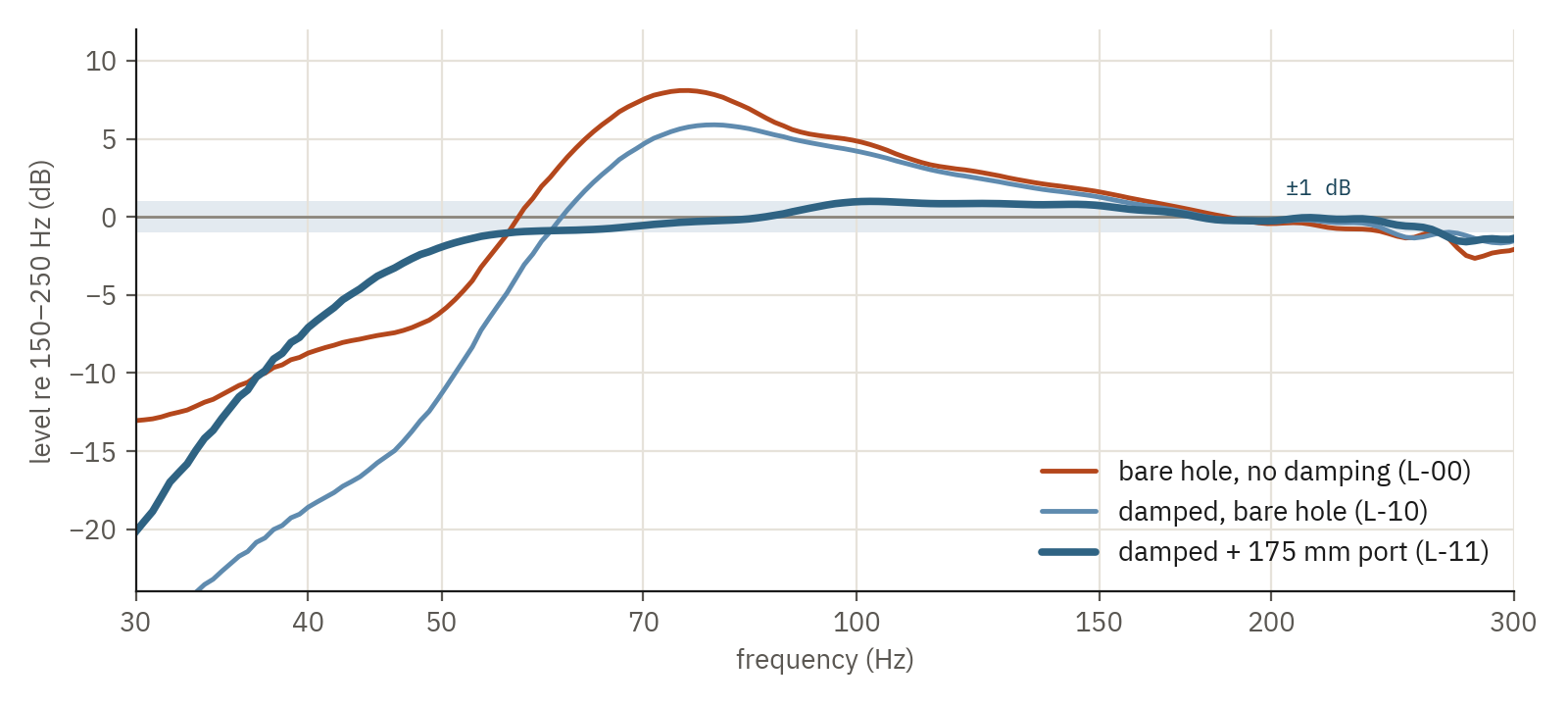
Bass, cone + port, levelled to 150–250 Hz: with the 175 mm port within ±1 dB from 55 to 150 Hz, −3 dB at 47 Hz, −7 dB at 40 Hz — "flat down to a point, then a clean roll-off". The length is right; it stays.
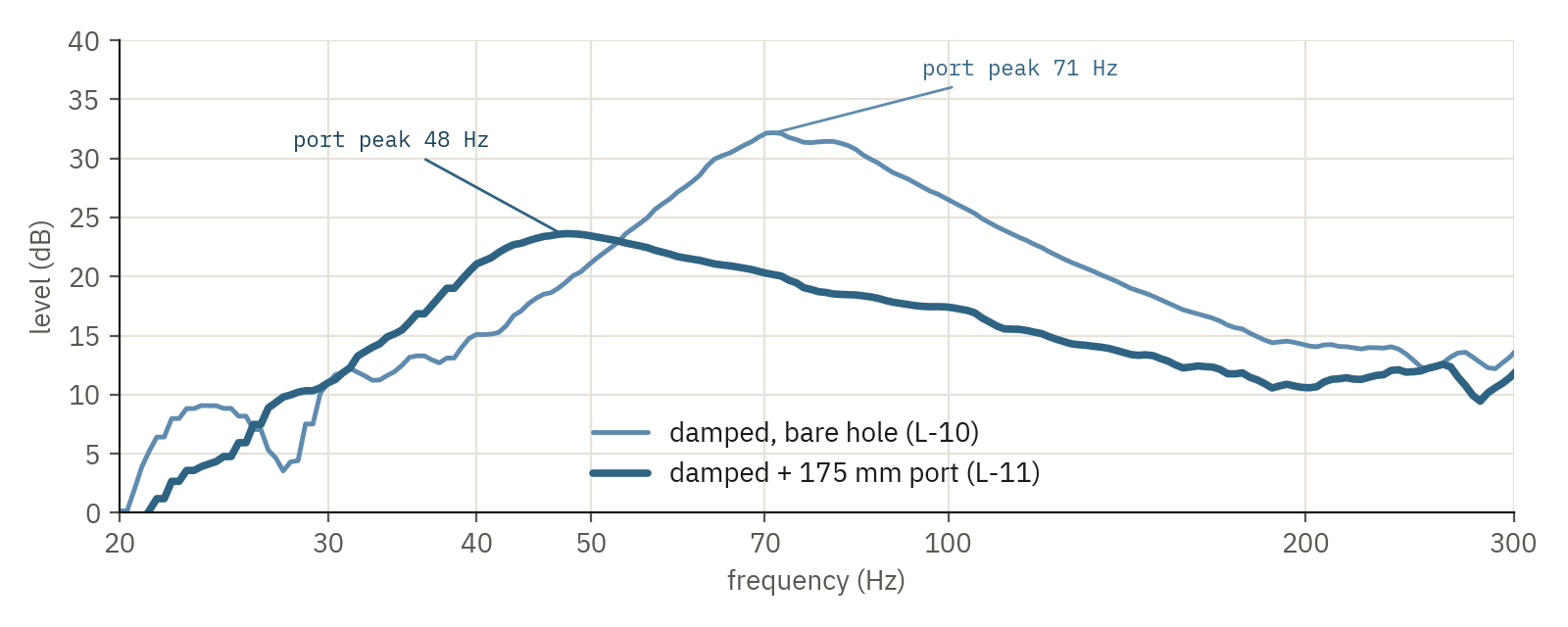
Port output: the peak — the tuning — moved from 71 to 47.6 Hz; the port delivers ~6 dB more at 40 Hz and leaves 70–100 Hz to the cone.
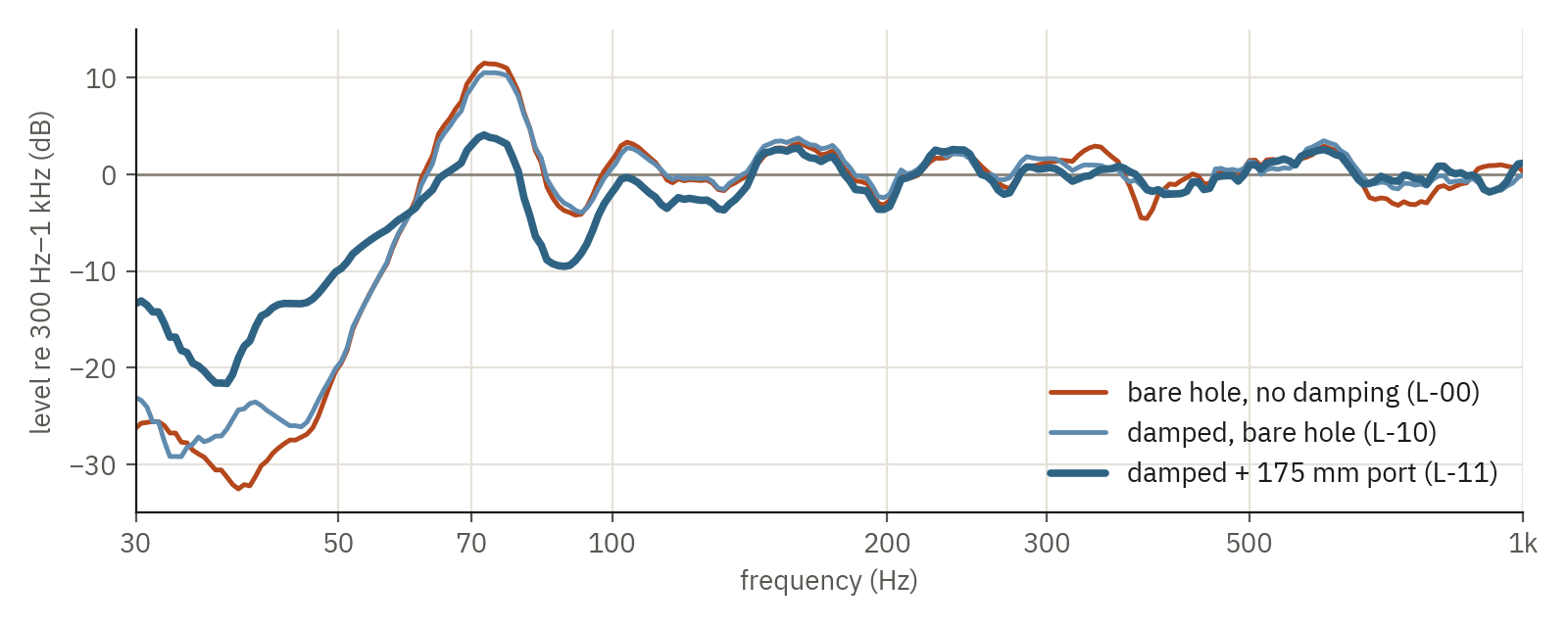
In the room (50 cm, 300 ms): the 70 Hz peak drops from +10 to +3 dB, 40–50 Hz rise by 6–12 dB. The room still shapes the bass (rear wall 50 cm behind the speaker) — that's for placement, not the tube.
| Damped, bare hole | 175 mm port | |
|---|---|---|
| Port tuning Fb | ≈ 72 Hz | ≈ 48 Hz |
| Bass hump | +5.9 dB at 79 Hz | none (max +1.0 dB) |
| −3 dB point | 58 Hz | 47 Hz |
| Bass sum at 40 Hz | −18.6 dB | −7.1 dB |
| Direct sound above 300 Hz | unchanged within 1 dB |
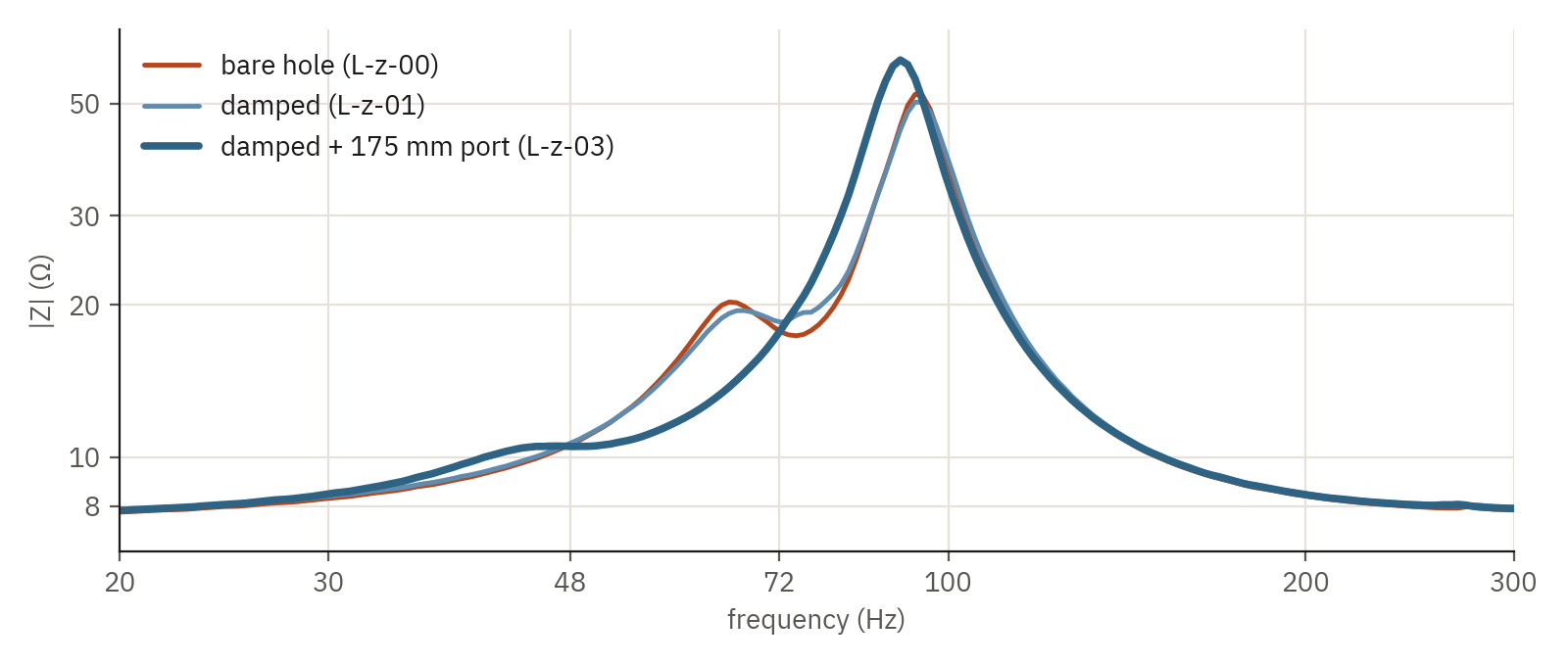
Impedance: the upper peak grows and moves from 93.8 to 91.1 Hz, as expected for a lower tuning. The lower peak and the dip that mark Fb shrink to a plateau at 45–50 Hz: the port resonance is heavily damped (the fill, and wool close to the tube's mouth). Taping every seam changed little, so it isn't a leak. Fb is therefore read from the port near field (47.6 Hz) and confirmed by the plateau (Impedance jig).
Listening
Equal-level test signals sent to one speaker at a time — a bass staircase of single notes from 40 to 120 Hz and a slow sweep 30–200 Hz — left speaker (175 mm port) against right (same damping, no tube yet).
"Not a huge bass addition, but the speaker sounds more balanced in some way."
That's the measurement in words: the tube doesn't add level, it removes the hump at 70–80 Hz that read as "lots of bass" and spreads the output evenly down to ~47 Hz.
Conclusion
- The first cut landed on target. Partly luck — but the prediction came from the measured tuning, and three independent checks (port near field, bass sum, impedance plateau) agree on ≈ 48 Hz.
- Measurement makes it verifiable, the ears make it final. Tuning further would trade evenness against bass quantity — a matter of taste.
- Balance, not quantity. For more bass level: placement closer to a wall (as the original design intends), a gentle EQ shelf, or loudness compensation.
Open
- Port noise at high level (only 4.7 cm to the back-panel wool): a loud listening test decides; if it chuffs, trim 10 mm (Fb +1–2 Hz).
- Protective high-pass in the DSP lowered from 56 Hz to 36 Hz (0.75 × Fb).