Step 1 — Damping
Question: what does the untreated box actually do, and what damping does it need? Result: three box resonances leak out of the port; a back-panel layout with one sheet of sheep's wool fleece per speaker plus a 50 g polyester pocket reduces them by 5–6 dB without touching the driver's direct sound.
Background: two terms
- Box modes. Above the bass, sound bounces between parallel inner walls and forms standing waves at f = c / 2L. In a vented box they escape through the port and colour the sound — "boxy" at the low ones, "honky" higher up. Damping material absorbs them.
- Fb, the port tuning. The air in the box acts as a spring, the air plug in the port as a mass; together they resonate at one frequency (a Helmholtz resonator, like blowing across a bottle). Fb is set by box volume and port dimensions, not by the driver. At Fb the port radiates most of the bass and the cone barely moves; below it the bass falls off steeply. A longer port lowers Fb.
Baseline findings
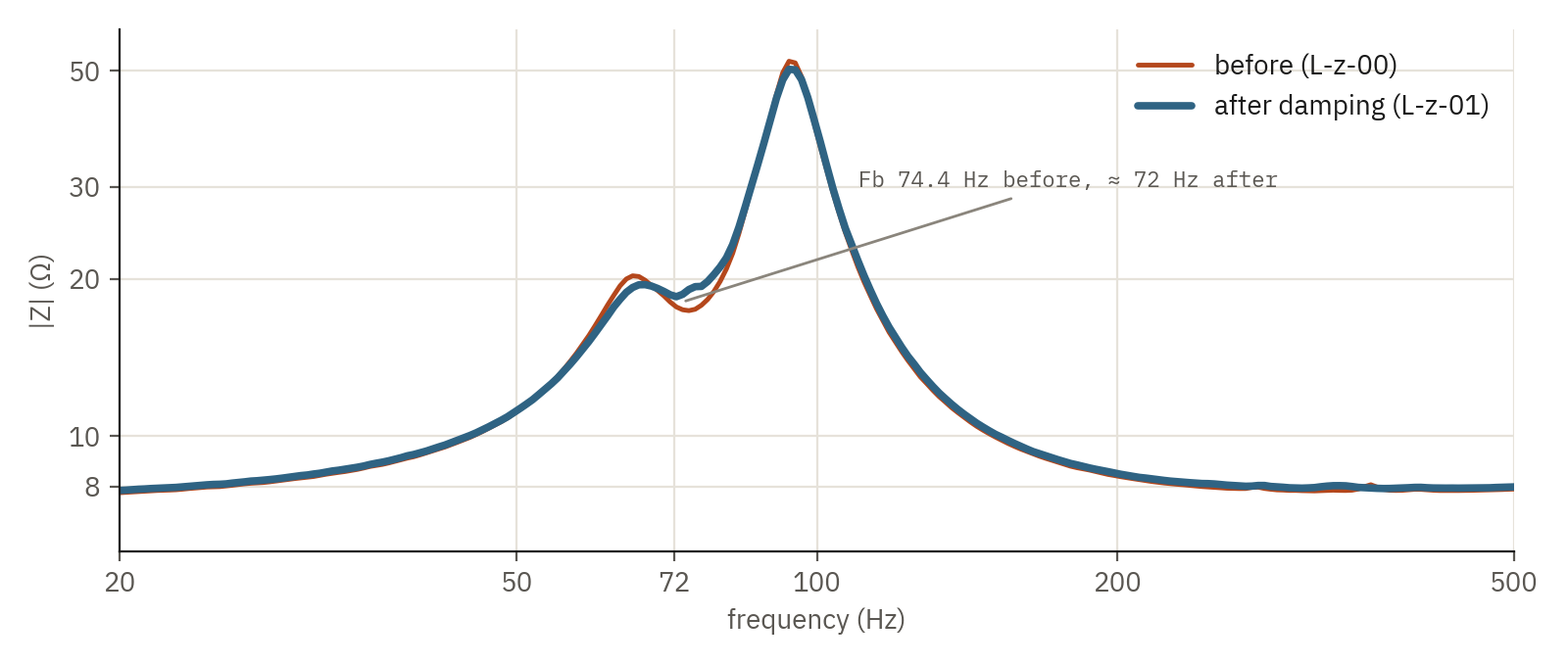
Untreated box: bare 44 mm port, no damping (L-z-00 impedance, L-00-baseline acoustic).
| Finding | Evidence | |
|---|---|---|
| P1 | The driver is the 8 Ω version. The supplied datasheet (Re 3.4 Ω, Fs 73 Hz, Qts 0.52) describes the 4 Ω version | impedance plateau 7.6–7.9 Ω; from the two peaks Fs ≈ 82 Hz, Vas ≈ 3.6 l (a new, stiff suspension) |
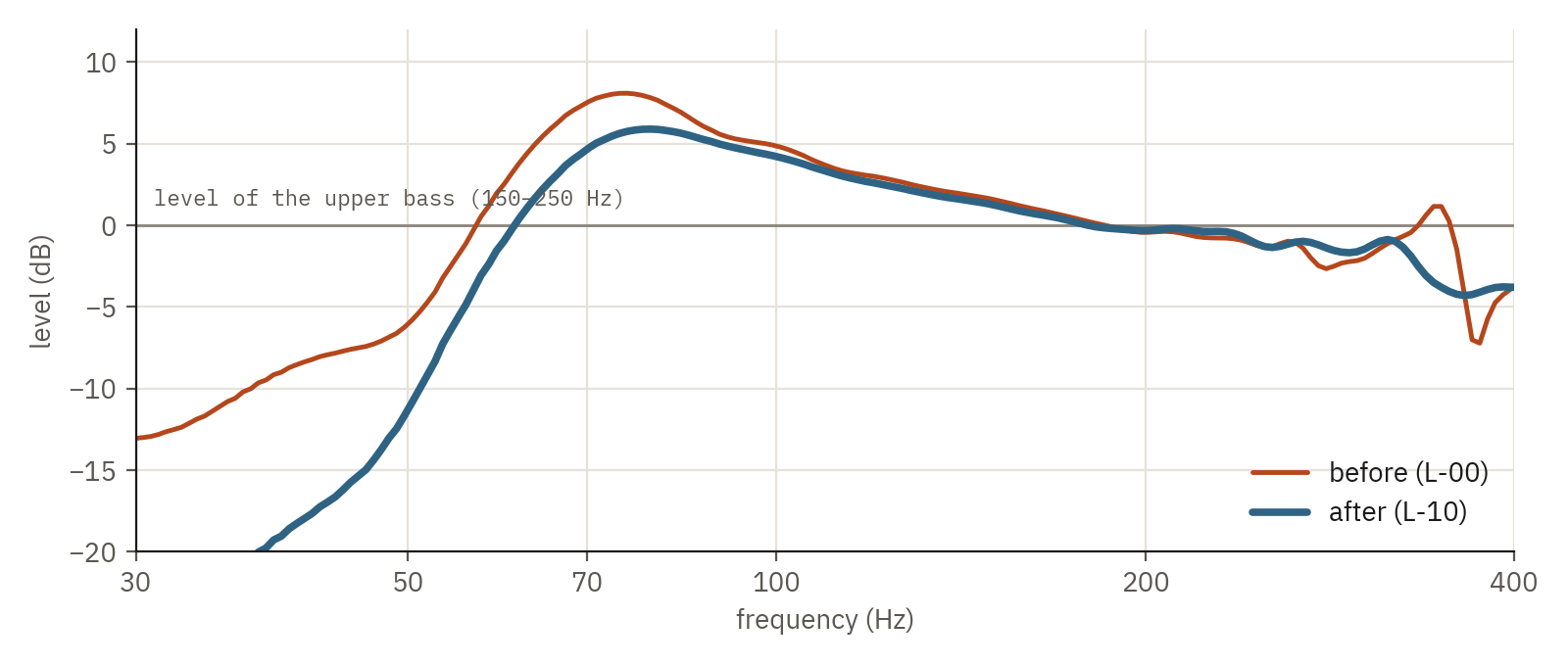
| P2 | Port tuned too high: boomy, shallow bass | Fb = 74.4 Hz (predicted 61 Hz); bass sum +8.1 dB at ~75 Hz, steep fall below 55 Hz → Step 2 |
| P3 | Height mode at 350 Hz | +13 dB spike in the port near field; c / 2·0.486 m = 353 Hz |
| P4 | "Honk" at ~950 Hz and ~1.5 kHz | ~950 Hz = front-to-back mode (c / 2·0.188 m = 912 Hz); ~1.5 kHz = the short port's own pipe resonance |
| P5 | Back panel leaks | taping the seams raised port output ~1 dB and moved its peak 1 Hz; refits moved it up to 10 Hz |
| P6 | Treble peaks | +7 dB at ~6 kHz, +11 dB at ~10.5 kHz (cone break-up) → correction EQ |
The box's dimensions predict the resonances that show up in the port output:
| Resonance | Dimension | Predicted | Measured |
|---|---|---|---|
| Height mode | 486 mm | 353 Hz | 350–360 Hz |
| Width mode | 296 mm | 579 Hz | not prominent |
| Depth mode | 188 mm | 912 Hz | ~945 Hz |
| Port pipe resonance | 44 mm + end corrections | ≈ 1.5 kHz | ~1.5 kHz |
Rationale
Porous material absorbs where the air moves, not where pressure builds:
- Height mode (350 Hz): air velocity is highest halfway between top and bottom, across the whole cross-section → thick, loose fill at mid-height. The original plan points the same way ("50 mm foam … better against the 300 Hz mode").
- Depth mode and port resonance: the front-to-back wave reflects off the back panel, opposite the port's inner end → wool on the back panel, and fill that reaches into the box depth.
Design goal for the production layout: one sheet of wool fleece per speaker, everything mounted on the removable back panel.
The chosen layout
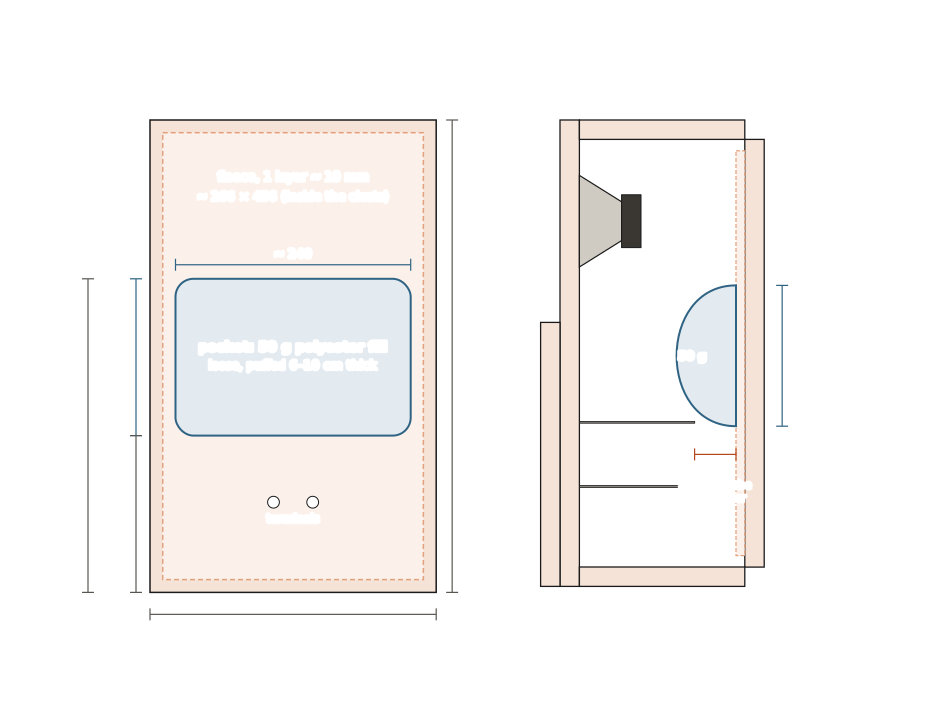
| Part | Size | Position |
|---|---|---|
| Fleece layer | ≈ 266 × 456 mm, one layer ≈ 10 mm (sheep's wool garden fleece, ≈ 140 g/m²) | inside of the back panel, within the cleats |
| ≈ 240 × 160 mm, made of the same fleece | across the back panel, 160–320 mm above the inner floor (middle third of the 486 mm height) | |
| Fill | 50 g polyester fibre fill, loose, puffed to 6–10 cm | inside the pocket |
| Clearance | ≈ 5 cm | around the port tube's mouth and behind the driver |
Test setup
The damping was studied as an experimental setup, not built as a finished interior: materials were added and taken out again between measurements, with everything else — microphone positions, gains, the box — held constant.
| Materials | sheep's wool garden fleece — unbleached, sold as a plant-protection / mulch mat, ≈ 10 mm, 350 g per 5 × 0.5 m roll (≈ 140 g/m²); polyester fibre fill (the synthetic stuffing found in ordinary pillows), weighed per round; a thin fabric bag or a wool pocket to hold the fill |
| Fixing | staples into the back panel, so each variant can be changed in minutes |
| Per round | one change, then port near field (all rounds) and far field + near-field driver (full sessions) |
| Outcome | a layout to build neatly in the finished speaker — not the stapled test fixture itself |
Note on the material: the original plan calls for dense 10 mm wool felt (≈ 1500 g/m²). The garden fleece used here is about ten times lighter and far cheaper — and with the pocket at mid-height it still takes 5–6 dB off every box resonance. Dense felt on the back panel would likely do more against the ~950 Hz depth mode.
Eight variants, measured
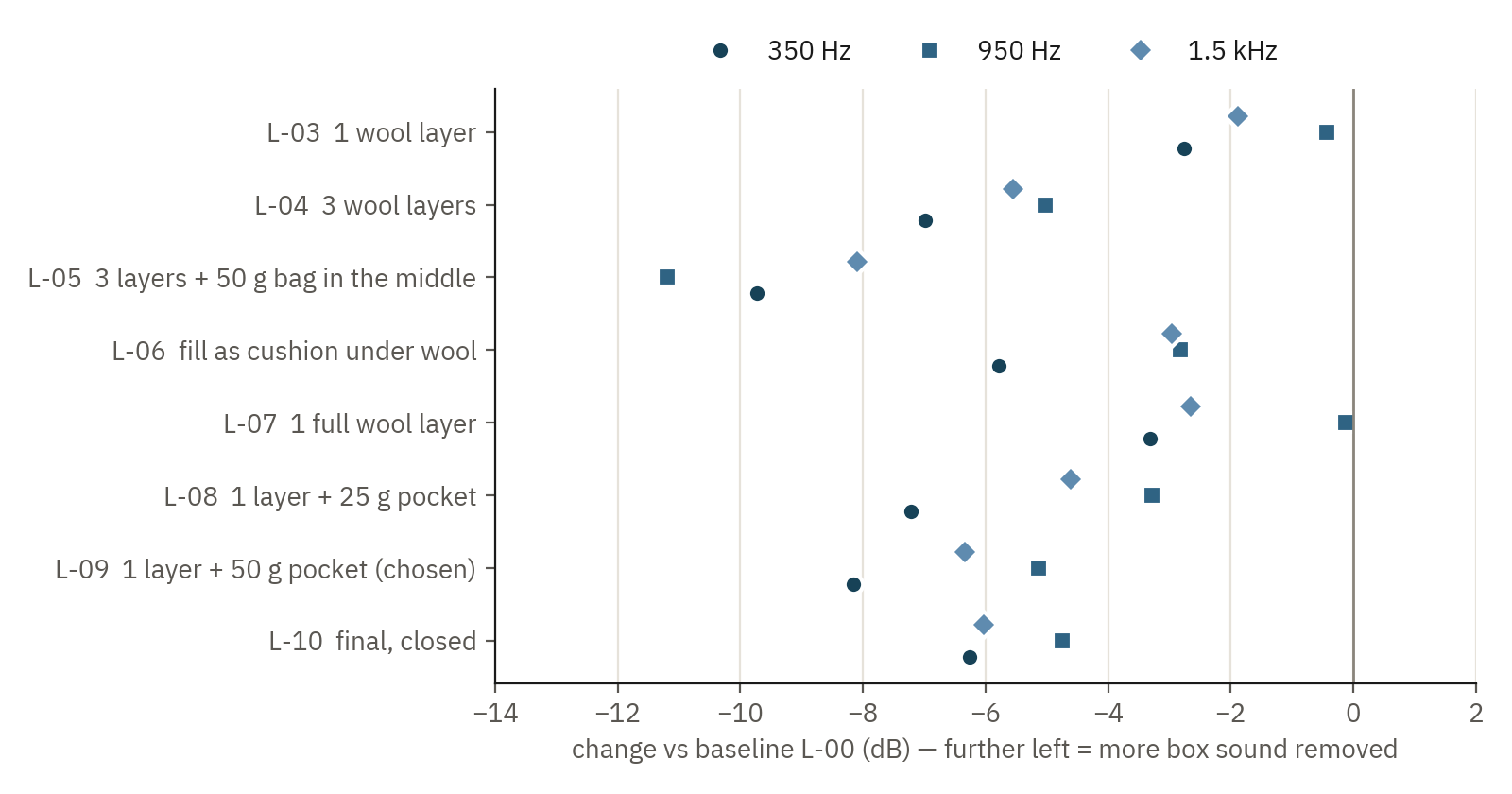
| Round | Change | 350 Hz | 950 Hz | 1.5 kHz |
|---|---|---|---|---|
L-03 |
1 wool layer (~10 mm) on the back panel | −2.8 | −0.4 | −1.9 |
L-04 |
3 wool layers on the back panel | −7.0 | −5.0 | −5.6 |
L-05 |
3 layers + 50 g fill in a bag, free in the middle of the box | −9.7 | −11.2 | −8.1 |
L-06 |
fill as a flat cushion under one wool layer | −5.8 | −2.8 | −3.0 |
L-07 |
1 wool layer over the whole back panel | −3.3 | −0.1 | −2.7 |
L-08 |
1 layer + 25 g fill in a wool pocket at mid-height | −7.2 | −3.3 | −4.6 |
L-09 |
1 layer + 50 g pocket at mid-height — the production layout | −8.2 | −5.1 | −6.3 |
L-10 |
L-09, stapled, panel closed |
−6.3 | −4.7 | −6.0 |
dB change of the band maximum in the port near field vs. the baseline L-00 (1/12 octave).
L-05 measures best; L-09 is the production layout: one fleece sheet per speaker, all on the back
panel, better than three plain layers, within 1.5 dB of L-05 at 350 Hz. Only the depth mode stays
~6 dB behind — a free-standing bag reaches into the box depth, a panel pocket can't.
Photos of three variants
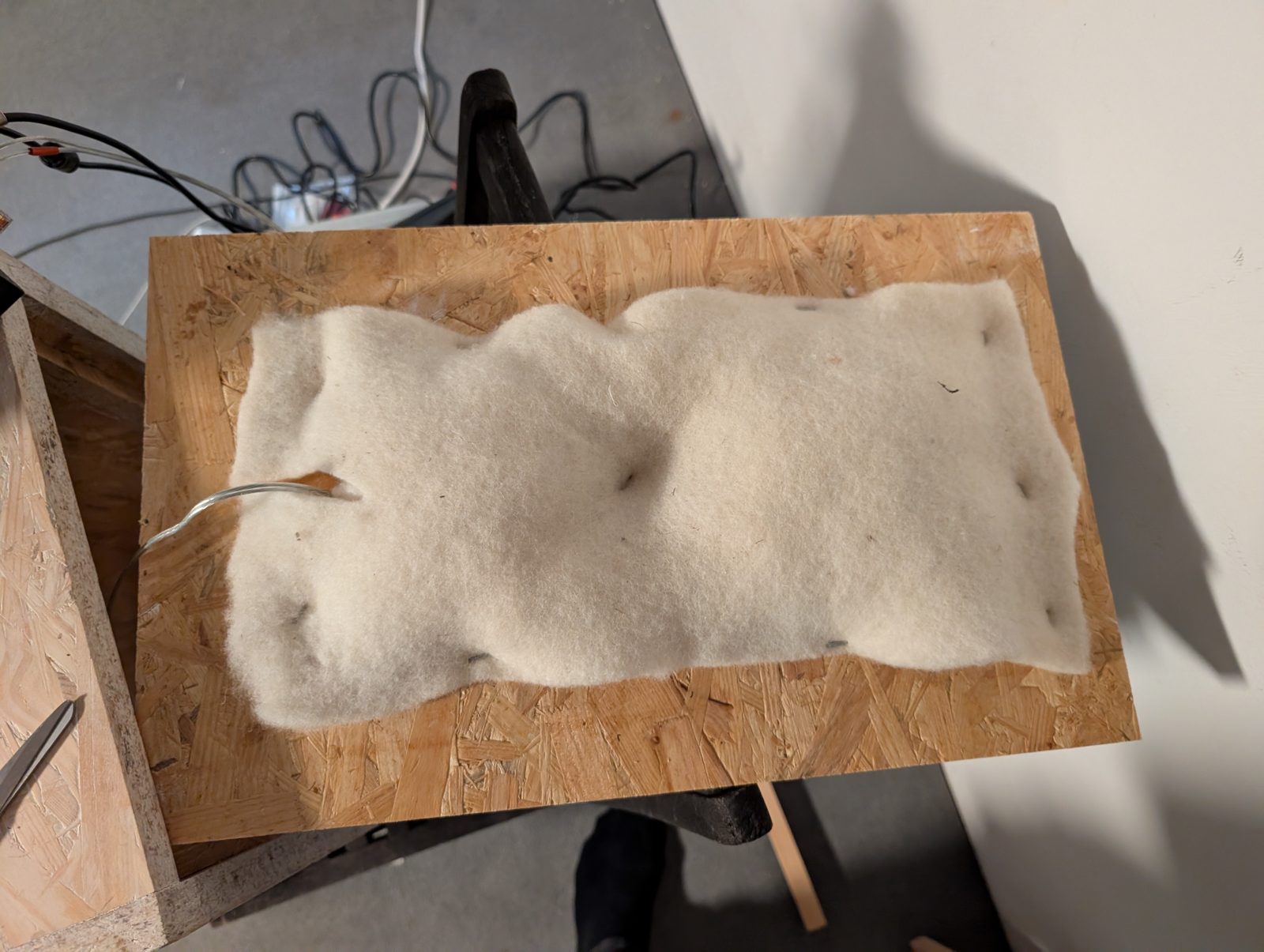 |
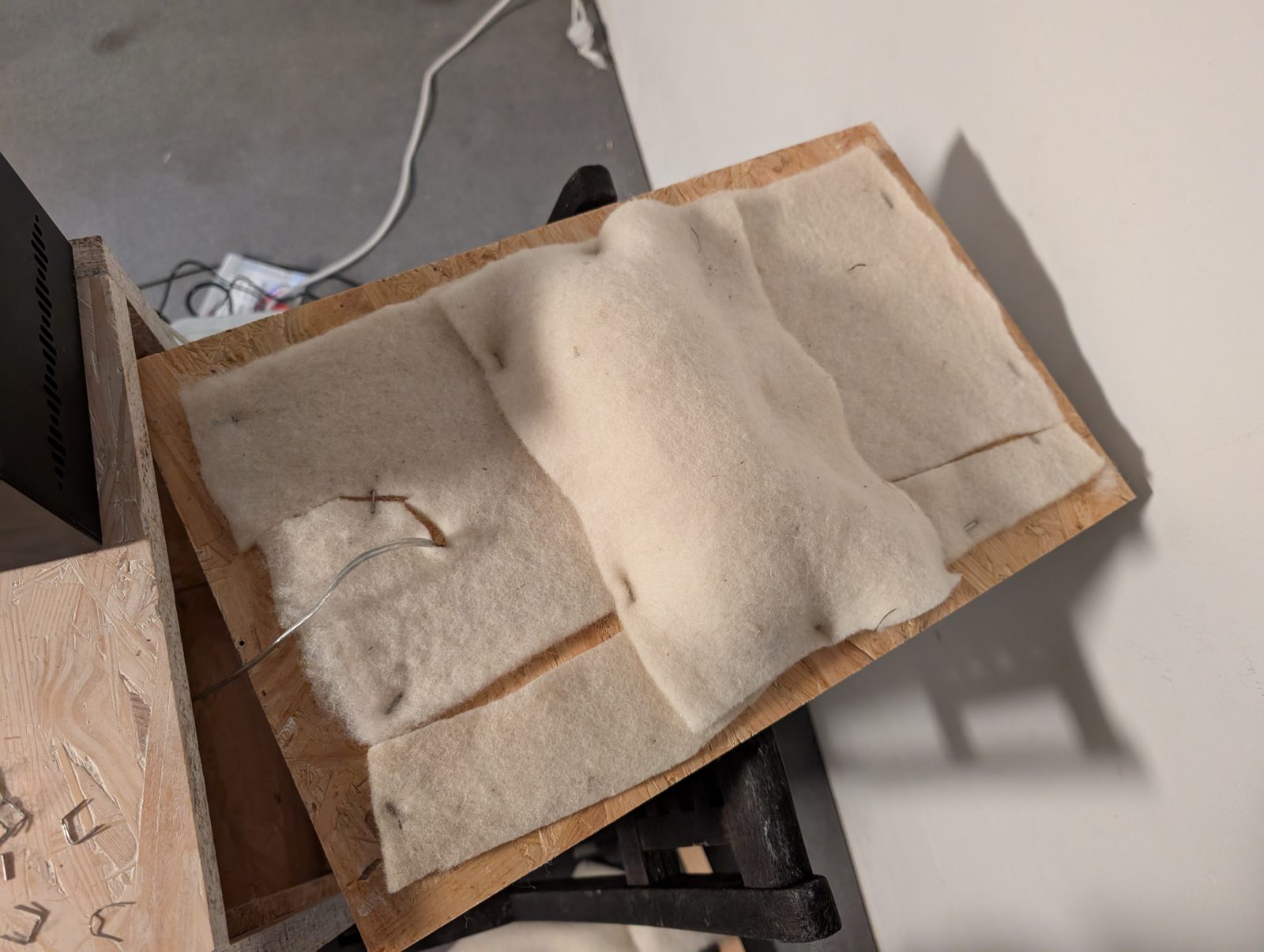 |
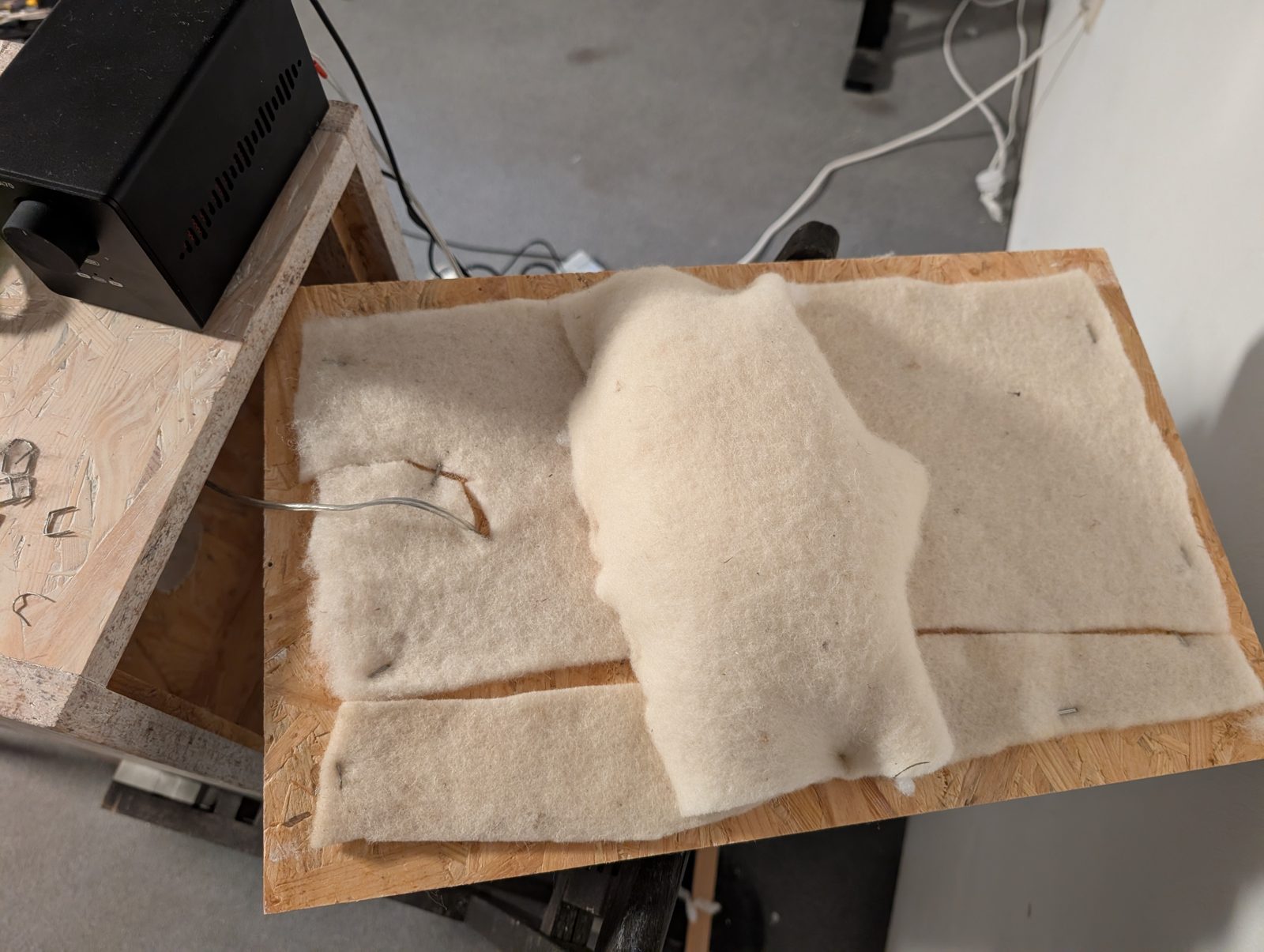 |
L-06: fill pressed flat — about half the effect of a puffy pocket |
L-08: one layer + 25 g pocket |
L-09: one layer + 50 g pocket |
Test setup: material stapled in so it could be added, moved or removed between rounds. The finished speakers get the same layout, neatly made.
Result
Port output — what leaks out of the box through the port:
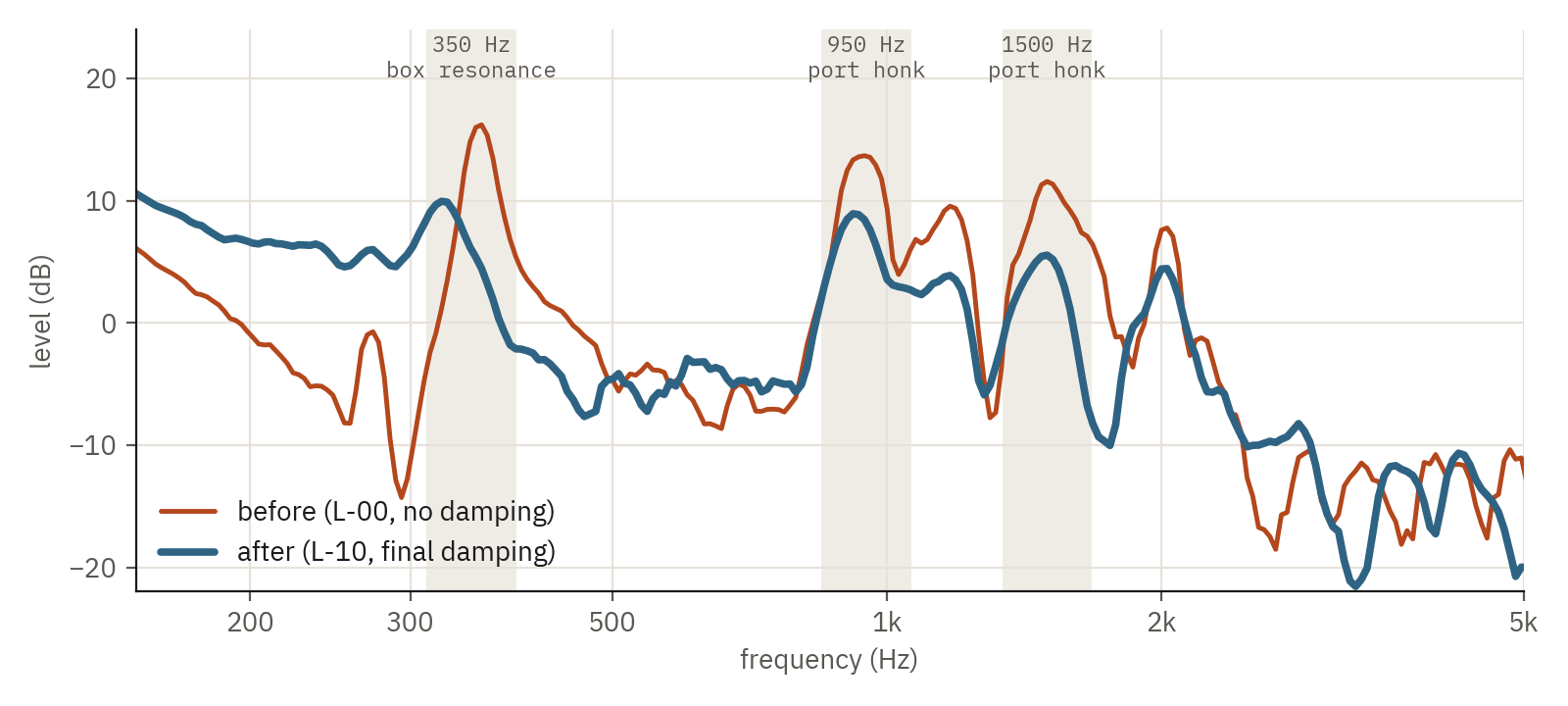
Port near field, 1/12 octave, 300 ms. The height mode, the depth mode and the port resonance are 5–6 dB lower.
Bass, driver + port — the hump at 75 Hz shrinks from +8.1 to +5.9 dB. The fill adds losses: the port gives up 1.5 dB at Fb and ~4 dB at 40 Hz, so the slope below 55 Hz gets steeper. The port tube in Step 2 moves this whole region.
Impedance — the tuning drops from 74.4 to ≈ 72 Hz (the fill makes the box act slightly larger). The dip between the bass peaks shrinks from ~3 Ω to ~1 Ω: more losses in the port circuit — the limit for further damping.
Direct sound at 50 cm (gated, room-free) — unchanged within ±1 dB, as intended: damping works on the box, not on the driver. In the room, at the mic, the 350 Hz region dropped ~2 dB.
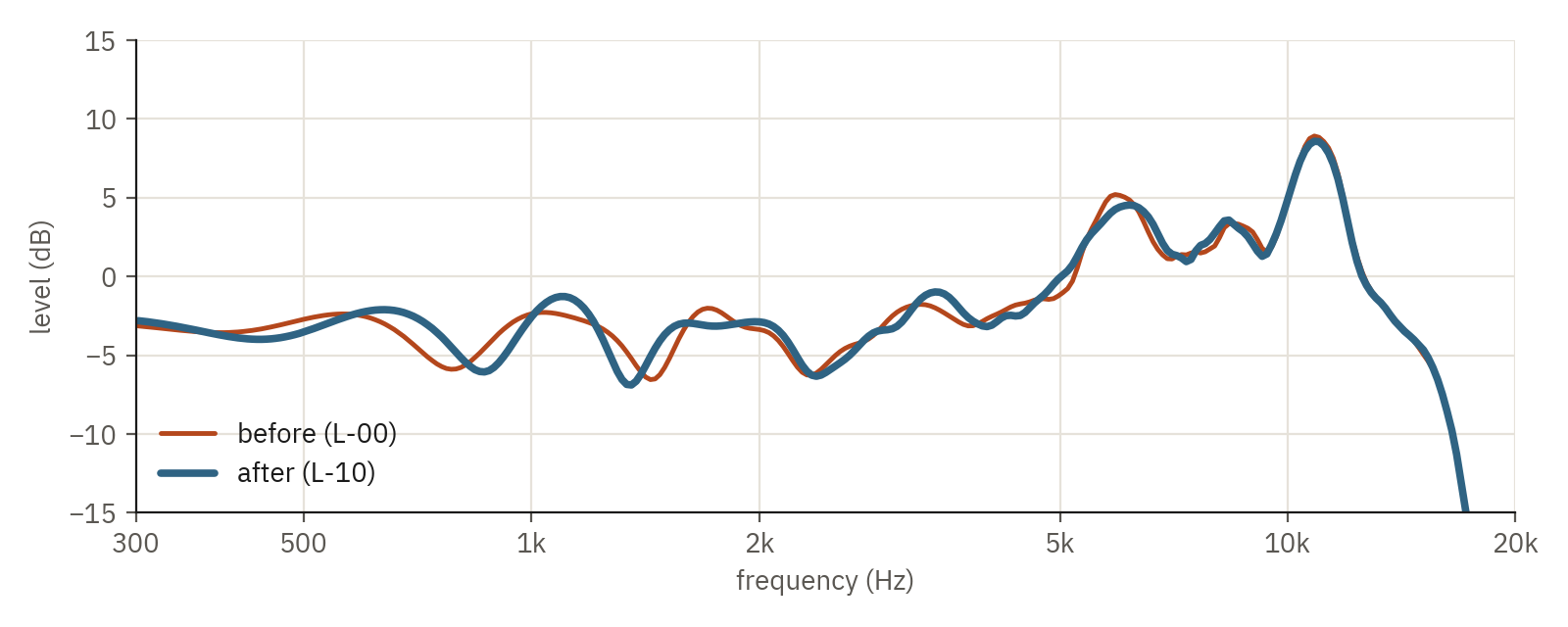
| Problem | Before (L-00) |
After (L-10) |
Status |
|---|---|---|---|
| P3 height mode, 350 Hz | +13 dB spike | −6.3 dB | largely solved |
| P4 depth mode ~950 Hz / port pipe ~1.5 kHz | clear peaks | −4.7 / −6.0 dB | reduced; 950 Hz could go further |
| P5 back panel leak | port peak 70–80 Hz depending on fit | 71 Hz, panel closed | build the back with gasket + screws |
| P2 bass hump / Fb too high | +8.1 dB, Fb 74.4 Hz | +5.9 dB, Fb ≈ 72 Hz | → Step 2 |
| P6 treble peaks | +7 / +11 dB | unchanged | correction EQ |
Limitations
- One speaker (L) measured; the second gets the same layout and one check measurement.
- The driver wasn't broken in: its suspension loosens over 10–20 h of use and moves the bass peaks a little.
- Port near-field data above ≈ 1.6 kHz are relative comparisons at a fixed position, not absolute levels.
- The friction-fit back panel's seating was the largest uncontrolled variable in the bass.
- The damping was measured as a test setup; the neat production version gets one confirming measurement.